Pages

Showing posts with label Little Corona City Beach. Show all posts

Sunday, August 22, 2010

Tattle Tale


Mother always knows best. When she noticed me heading out the door in my swimming trunks, she reminded me not to jump in the ocean with my phone in my pocket.

"I know, Mom!" I called over my shoulder as I slammed the door.

It was going to be a good day. My friend Tim and I had planned a leisurely day of birding, swimming, and getting stuck in traffic jams in Orange County. "Ready to see tattlers?" I asked as we backed out of the driveway. I saw the neighbor's car just in time and slammed on the brakes.

Half an hour later, we pulled up at the Most Reliable Tattler Spot in Orange County (also known as Little Corona City Beach) and headed down to the shore, all the California beach birding essentials in tow: binoculars, camera, swimsuit, and flip-flops. I had the home field advantage, so it was merely seconds before I had the scope on a Wandering Tattler perched on one of the preferred rocks. Our target easily disposed of, we wandered (heh...no pun intended) down to the beach itself. I scoped the waters offshore while Tim sauntered off to photograph a Whimbrel on another patch of rocks.

Several minutes passed. The Whimbrel flew off, but Tim was still intent on someone on those rocks. I decided to investigate, and found him photographing a couple tattlers at obscenely close range. I quickly ditched my scope and splashed into the tidepools to join him.

Then, I remembered something. Feeling very clever, I turned around and deposited my phone, keys, and wallet by my scope on the beach. I waddled back into the tidepool on my knees, cradling my camera and trying to ignore the chilly water that engulfed the lower half of my body. The tattlers, unimpressed by my antics, napped on the rocks.


Eventually, I worked my way close enough (carefully avoiding particularly jagged-looking rocks and sea anemones) to wake up one of the birds.


Tattlers aren't overly fancy, but somehow they manage to endear themselves to most birders. Perhaps it's their comical teetering, or the way they scamper energetically over the rocks, or their own subtle beauty...


Thirty minutes had passed before we had clicked away to our satisfaction. Surprisingly, I remembered to retrieve my affects on the way back to the car. I even remembered to take my phone back out of my pocket when we went swimming later in the afternoon.

My unfortunate wallet, however, remained forgotten in my pocket and went boogey-boarding with me.

Saturday, August 15, 2009

The Sea


Walter, a young Beechey Ground-Squirrel, heard the unmistakable sounds of a granola bar being extricated from its wrapper. Good news. Walter was hungry, so he emerged onto the sidewalk from the adjacent garden to wheedle an innocent tourist out of his snack. He was quick to notice the coveted granola bar cradled in the hands of a human standing in front of an odd, three-legged animal. The breeze shifted, and Walter caught a whiff of the prize - mmmmmm, Oats and Honey! Sauntering toward the human, Walter employed every little trick that usually won the attention of humans, only to be ignored. The human, standing immobile before the three-legged animal, did not even acknowledge Walter's presence. After a few minutes of unsuccessful begging, Walter stomped off in search of easier prey.

I yawned, jammed my eyeball to the scope eyepiece, and stared at the distant water magnified through the mist. Occasionally the shadowy form of a shearwater would flit out of the mist, usually quickly disappearing. A swirling flock of Sooty Shearwaters drew my attention to a small pod of dolphins offshore. There wasn't much else to see; the mist obscured everything more than a mile or two offshore, and few birds seemed to be flying. Already bored after only ten minutes of seawatching, I fished a granola bar out of my bike bag and began munching while scanning for seabirds, barely noticing a Beechey Ground-Squirrel moseying around on the sidewalk next to me.

Giving up on seawatching, I strolled down to the beach, thinking the whole time Darn, did I just ride twenty-one miles to see a bunch of mist and some Sooty Shearwaters? My shoes began filling with sand the instant I stepped off the concrete walkway and onto the beach. Working my way over to one of the rock formations (having to leap over a creek with my scope, camera, binoculars, water bottle, etc., in the process), I began scanning for shorebirds. Hopping from rock to rock until I found a good spot to set up my scope, I cursed the sharp, jagged rocks and made a mental note to wear studier shoes than Converse next time I visited the place.


Shorebirds were scarce. Suddenly, a medium-sized black shorebird appeared atop a distant rock. I couldn't believe my luck - a Black Oystercatcher! I trained my scope on it, finding a crow exactly where the oystercatcher had been sitting. Hmmm.

Two Black-bellied Plovers wandered through the flock of motley gulls, occasionally giving mournful whistles as if they were sad about being the only genuine shorebirds around.


After scrutinizing the rest of the rocks and finding no other shorebirds, I turned my attention to the jetty of the adjacent Newport Harbor. Shorebirds generally don't like the jetty as much as the natural rock formations, but they must have forgotten that this morning; I quickly spotted a few Black Turnstones. I watched a different grayish shorebird I suspected was a Wandering Tattler until it took flight, showing no white in the wings or tail. Wandering Tattler indeed. My first new Bigby bird. At last, the morning seemed to be shedding its grim atmosphere.

The mist appeared to be burning off a bit, so I climbed back to the top of the bluff to take another shot at seawatching. After scanning and finding nothing except the same shearwaters and dolphins, I turned my attention to the terns swirling and diving over the ocean, hoping to pick out a more unusual species. In just a few minutes, I did, though you wouldn't guess judging just by the name - Common Tern. This species is a rather uncommon migrant through Orange County, and I missed it for my Bigby list last year. This tern, in fact, led me to my next new Bigby bird as it was flyin' roun' an' stuff over the ocean: three Red-necked Phalaropes bobbing around amongst the waves.

I was busy watching another tight little knot of phalaropes buzzing in for a landing beside their buddies when a feminine voice brimming with curiosity asked "Whatcha lookin' at?"
"Seabirds," I replied laconically, jerking my head to acknowledge the woman's presence.
"Seabirds?" She repeated in a voice that suggested that she doubted the existence of such creates.
"Way out," I said, nodding, affirming their existence, as she continued walking down towards the beach.

They - the hordes of beach goers - streamed by, I'm sure all curious, but most not bold enough to ask what a scruffy teenager was doing pointing something that looked vaguely like a missile launcher out to sea. Most people just walk by, sometimes so busy staring that they trip over my tripod. At least a couple people usually end up talking to me about birds or cameras each time I go seawatching. The tourists are part of the fun of seawatching - scaring them, having conversation with them, ignoring them, or impressing them by informing them that yes, I really did ride that bike twenty-one miles to get here just to look at birds.

After the interruption, I looked back at the phalaropes only to discover a dozen more had arrived. Small parties flew by often, some of them stopping, others hurrying on. Lots of phalaropes. The novelty of the phalaropes wore off after a while, so I pointed my scope farther offshore. The decreasing amount of mist revealed increasing numbers of shearwaters. Lines of dozens of Sooty Shearwaters cruised by, and after some careful scanning I spotted a single Pink-footed Shearwater and a few Black Storm-Petrels. Then...

OHMYGOSH A SMALLDARKBIRD BUZZINGTHEWATERACLID! I followed it in my scope, carefully noting characteristics that identified it as a Rhinoceros Auklet. It was mostly dark (not smartly black and white like a Xantus's Murrelet), but with a paler belly and slower wing beats than a Cassin's Auklet. Needless to say, this was another Bigby bird for me, and a decent one at that - I think it's pretty neat to have an alcid on my Bigby list.

Around ten, I decided to leave after over two hours of seawatching. I packed up my affects and bade goodbye to the seabirds, shorebirds, and beach goers as I wearily pedaled off down the street in the direction of home. Seawatching is always enjoyable (at least when there are seabirds to see!), but it is particularly fun to do by bike. It's a long trip (I put forty-four miles on my bike today) and requires an early start (I had to leave my house before a lot of the birds woke up!), but the payoff is worth it.

Saturday, July 4, 2009

The Final Frontier


I'll take a break from my narration of the Young Birder's Conference to report on my day of biking and birding today. Last night, upon discovering that I had no plans for the next day, I decided to ride my bike down to the beach and try to get some sea birds for my Bigby list. Pelagics are awfully hard to get for Bigby lists, and prior to today I had only gotten Black-vented Shearwater and a few loons for a couple brief seawatching sessions.

One common misconception of seawatching is that it can be done at any time of day. This is simply not true. Seawatching is overwhelmingly more productive the first couple hours of day. This presents a problem for bigbying. The nearest beach is a twenty-one mile ride from my house, probably an hour and half of riding. To remedy this problem, I left my house very early, around five-twenty, and pedaled like the devil to the west. I didn't allow myself any stops; I didn't even stop when a Clapper Rail sounded off near the road at Upper Newport Bay. It was my first new Bigby bird of the day.

My relentless pedaling paid off; I reached Little Corona City Beach at ten til seven. Unfortunately, seawatching conditions weren't optimal; it was clear, and the ocean was as slick as glass. Under conditions like these, the birds are usually farther offshore. They were. After a few minutes of scanning, I managed to spot a couple Black Storm-Petrels way out over the ocean. A few Sooty Shearwaters began to trickle by several miles out. After an hour of staring out to sea, I finally spotted a bigger shearwater with lumbering wingbeats; when it banked, I could see its pale underparts. A Pink-footed Shearwater! To make matters even sweeter, an out of season Pacific Loon winged by. All these, along with Elegant Tern, were new Bigby birds for me. Also new for my Bigby list were these sea stars clinging to a rock below the overlook.


After eight o'clock the sea birds thinned out, so I loaded my bike back down and retraced my steps. I actually stopped for birds on my return trip around Upper Newport Bay, but I didn't find much. A smattering of early migrant shorebirds - Willets, Western Sandpipers, Short-billed Dowitchers, and others - were present, but otherwise it was very quiet. Even the large Black Skimmer colony, usually bustling with noisy activity, was deserted. Here's a shot showing a smattering of the birds present: Mallards, Snowy Egrets, Caspian Terns, Black Skimmers, Willets, and Marbled Godwits.


After the mandatory lunch stop at In-N-Out Burger, I birded around San Joaquin Wildlife Sanctuary in Irvine for about an hour around midday. I wasn't expecting much, and indeed there weren't too many birds around. I did, however, find one exciting new Bigby bird. I was poking around the edge of one of the ponds looking for dragonflies when I heard the unmistakeable call of a Least Bittern from a nearby stand of tules. I crept forward, craned my neck, and peered into the tules, but it was buried out of sight. I walked around to the other side of the pond to scan the tules, and after a couple minutes of futile searching, the bittern suddenly burst from the vegetation and gave me a very brief view as it flew across the pond and melted back into the tules. This species is incredibly elusive and I was not sure whether I would get it for my Bigby list this year.

Birds may not have been overly plentiful at San Joaquin this afternoon, but dragonflies were. Unfortunately, since I had my scope, I couldn't bring my good camera to photograph them with. Several got away unidentified, including one that I'm fairly confident was a Spot-winged Glider. One dragonfly that actually cooperated for photos was this gorgeous Blue-eyed Darner. I digiscoped it from fifteen feet away... I can't say I've digiscoped a dragonfly before!


I headed for home around twelve-thirty. I took my time getting home, particularly going up the arduous hill along Jamboree Road, since it was hot and I was weary. I rode forty-four miles and saw seven new Bigby species - over six miles per bird! Despite this seemingly low number of new species, it will probably be the most new species I get in one day for the rest of the year. I will have to get back down to the beach by bike to get some more sea birds for my Bigby list - alcids and jaegers, perhaps?

Sunday, March 1, 2009

You set a record?!


Birding by bike has always intrigued me, particularly since moving to California, which is much more biking-friendly than Michigan. I don’t do so much biking to reduce my carbon footprint (more on that at some other time), but because it is fun and convenient. Soon after becoming hooked on birding by bike, I was very excited to break the one hundred barrier for a day. Over the past year and a half, I’ve broken that record again and again, until my biggest biking day total was one thirty-six. This is a pretty intimidating total to break, but I figured it was possible. I had nothing better to do on Saturday, so on Friday evening I decided to take a crack at the record.

My route was roughly as follows: San Joaquin Wildlife Sanctuary, Upper Newport Bay, Little Corona City Beach, Irvine Regional Park, and Santiago Oaks Regional Park. This is a lot of ground to cover! I left my house at dawn and sped toward San Joaquin. This is always a fun ride; I can attain speeds up to thirty-five miles per hour going down the enormous hill along Jamboree Road. I arrived at San Joaquin at seven forty, having already picked up a few key birds on the way down, including Wilson’s Snipe, White-faced Ibis, and Yellow Warbler in the San Diego Creek and Chipping Sparrow at a little park near my house.

I had already decided to not waste a lot of my precious time at San Joaquin. It is a great birding spot, but I often trick myself into searching for the Northern Waterthrush that doesn’t seem to exist there. I gave myself twenty minutes. My first spot to check was Pond Two, where some Ross’s Geese apparently have been spending the night recently. I was either too late or the geese have disappeared for good, because the only geese in the pond were Canada Geese. I did get a much-appreciated consolation prize in the form of a gorgeous adult-cycle Mew Gull mixed in with the Ring-billed and California Gulls loafing on one of the islands. I returned to the Audubon House, found the continuing Wilson’s Warbler in the vegetation around the parking lot, and then ran out to Pond B to see my only Black-crowned Night-Herons of the day. I pulled out of the parking lot at eight sharp.

Upper Newport Bay could make or break my day, since I depended on it to produce lots of ducks, shorebirds, and raptors for my list. The tide wasn’t optimal (high, but it was only a three-footer), but I found lots of birds anyway. Numbers and variety were a bit down from my other recent visits, and I struck out on a few much-needed species like Loggerhead Shrike, Merlin, and Eurasian Wigeon. However, I came through with a number of problematic species, including Sora, Horned Grebe, and Canvasback.


The beach is always an important spot on any Orange County Big Day. Little Corona City Beach isn’t the best beach for birding, but it is the closest and most convenient. On the way to the beach, I stopped to pish at a well-vegetated yard adjacent to Pacific Coast Highway near Fashion Island. I was hoping for a Townsend’s Warbler or something along those lines. I was downright shocked when the first bird to pop up was a White-throated Sparrow. While hardly a earth-breaking rarity (at least six or seven are wintering in the county this year), it was unexpected. Surprisingly, it wasn’t a Bigby bird for me, as I saw one in early January at Mason Regional Park. After a few more minutes of pishing, my hoped for Townsend’s Warbler did show up.

After weaving through some of the quaint neighborhoods of Corona del Mar, I arrived at Little Corona City Beach. The most conspicuous birds were the Brandt’s Cormorants and Brown Pelicans loafing on the rocks below the overlook. Among them I picked out a single Pelagic Cormorant. The few rocks that weren’t submerged were free of shorebirds. Finally, I spotted a few little bumps that were most likely shorebirds on some rocks at least half a mile down the beach. It was too hazy to scan offshore, so I set off down the beach to get a closer look at the shorebirds. It was more difficult than I anticipated. At several points, the tide forced me to spider along narrow cliff edges to continue down the beach (I had my scope on my shoulder the whole while, mind you.) I finally was able to approach the birds closely enough to identify Surfbirds, Black and Ruddy Turnstones, Willets, Whimbrels, and Marbled Godwits. I also spotted a Red-breasted Merganser, the only one of the day.

By now the haze had burned off somewhat, so I returned to the overlook to scope offshore. While munching on my lunch, I spotted a few Black-vented Shearwaters, singles of Common and Red-throated Loons, and a handful of Surf Scoters. Pretty meager fair, but it was better than nothing.

Around noon I headed back in the direction of Irvine and Santiago Oaks Regional Parks. After a long and difficult uphill ride, I arrived at Irvine Regional Park mid-afternoon. I quickly found most of my targets without difficulty, including Wood Duck, Ring-necked Duck, Acorn Woodpecker, Oak Titmouse, and Lark Sparrow. I continued on to Santiago Oaks Regional Park, hoping to scrape out a few additional species. The first bird I tried for, the Yellow-bellied Sapsucker, was nowhere to be found. I never seem capable of locating him when I really need to. However, I did managed to pish up one of the Golden-crowned Sparrows I had come across the previous day. After picked up a couple more common foothill species, I wearily pedaled home as daylight faded.

I anxiously tallied up my checklist upon arriving home. Did I find enough to break my record? I got a few surprise birds, but I also missed some easy ones (Green Heron, Wandering Tattler, Cooper’s Hawk, etc.) Turns out all the pedaling paid off (53.21 miles, to be exact) – my total for the day was one hundred forty-one. That’s a decent total for a day of birding in Orange County by car, let alone by bike. It will be extremely difficult to break this record, though if I really tried (i.e., looked for owls, kept a tighter schedule, staked out more birds) I could likely attain one fifty. Additionally, I added eighteen new species to my Bigby list, mainly common beach species. It was a pretty awesome day of birding.

Sunday, November 30, 2008

One Boy, One Bike, One Day

Nothing was on my schedule for Saturday, so I decided to take a crack at my record Bigby day (128). Finding this many species in one day requires covering lots of different habitats, such as seashore, estuary, freshwater marsh, and more. I ran my traditional biking route - down the mountains to sea trail to the coast. Unfortunately, days are short this time of year, so I was pressed for time. This difficulty is offset, however, by the diversity of birds around this time of year. I figured that the record would be fairly easy to beat, since I had made it without really trying.

It was a nippy fifty-two degrees when I pedaled out of my garage and down the street. Feeling only slightly ridiculous wearing a jacket and biking tights with binoculars slung around my neck, I sped towards the distant coast. I briefly paused at Peters Canyon, but after that I rode nonstop to San Joaquin Wildlife Sanctuary in Irvine. On the way, I found White-faced Ibis, Common Moorhen, and others without even slowing my pace.

I blew a good chunk of prime morning time at San Joaquin. If I were to do it again, I wouldn't spend as much time there, but I wanted to look for some of the interesting birds that had been reported there recently, including a Northern Waterthrush. According to the rare bird alert, the waterthrush had been seen in the "back area" - a flooded swamp acres large. I did find some interesting birds back in there, including Red-naped Sapsucker, Hutton's Vireo, Northern Flicker, and White-throated Swift. I dawdled around more, and didn't get out of there until ten-thirty.

To make up for the lost time, I frantically raced around Upper Newport Bay. It was high tide, anyway - about the worst time to look for most birds there. I figured I could catch some of the birds I missed on the way home, when tide was lower. I couldn't resist making a few quick stops, during which I found birds such as Horned Grebe, Marbled Godwit, Loggerhead Shrike (undoubtedly the same one I saw a couple weeks ago), and Whimbrel. I continued on towards Little Corona City Beach, where I hoped to find some birds more typical of the seashore.

On the way, I had to stop at the 76 gas station at PCH and Avocado to pick up a king-sized Hershey chocolate and almond candy bar. I think this is becoming a tradition. I arrived at Little Corona City Beach several minutes later. I began scoping the ocean while munching contentedly on my candy bar. Through the haze I spotted flocks of Black-vented Shearwaters skimming the water, Pacific Loons, and a new Bigby bird, a Common Loon. I descended to the beach to check the rocks for shorebirds. I was specifically interested in finding Black Oystercatchers, a species that has eluded me on my previous visits and kept off my Bigby list. I found lots of the common rocky shorebirds - Black Turnstones, Ruddy Turnstones, Surfbirds, and even a Wandering Tattler - but not oystercatchers. I picked my way across the rocks (climbing slick rocks with a scope on the shoulder should become an Olympic sport) to get a look around a bluff that was blocking my view of the rest of the beach. I reached a nice solid rock, and set up my scope on the uneven slimy surface. I carefully inspected the distant rocks, finding lots of turnstones and Surfbirds, and then... three Black Oystercatchers came out of nowhere, as certain people would say. I was still on a Big Day schedule, but I stopped and watched the oystercatchers for several minutes. Satisfied that I had vanquished another nemesis Bigby bird, I hopped back on my bike and headed back the way I had come.

By the time I got back to Upper Newport Back, the tide was lower and the birds were easier to find. Careful scanning of the enormous flocks of ducks and shorebirds produced some interesting new species for the day, including Eurasian Wigeon, Blue-winged Teal, Long-billed Curlew, and Dunlin. After glancing at the sun's low position in the sky, I decided I'd better hustle along if I wanted time to stop a couple more times. A five-minute spin through Mason Regional Park quickly produced Canada Goose and Townsend's Warbler, both new birds for the day. I knew of a Yellow Warbler wintering in a patch of willows in the San Diego Creek right along the bike trail, so I stopped and aimed some full-caliber pishes in the direction of the trees where it is wintering. The poor bird never had a chance. It immediately popped up, chipping away, and I also immediately popped onto my bike and pressed on. It took less than ten seconds.

After a lengthy ride, I arrived at Irvine Regional Park. I furiously dashed around the park, picking up several species characteristic of the foothills: Acorn Woodpecker, Oak Titmouse, and Western Scrub-Jay. I headed for home as the sun sank behind the hills. When I finally arrived home, I immediately counted up my list to see if I had broken the record. I had, and by a decent margin - my total for the day was 136. That's a fairly impressive total for one day on a bike, though I missed quite a few possibilities: Red-breasted Sapsucker, Lark Sparrow, Red Knot, Fox Sparrow, and others. I biked roughly forty-five miles and found two new Bigby birds, bringing my total up to 229. One hundred and forty in one day is the next barrier to break, but I think that will have to wait until next year.

Sunday, November 9, 2008

There And Back Again


The old bike creaked and complained as I labored up the hill. It endured several years of loving abuse by my eldest brother, followed by a couple years of dormancy in a dusty corner of the garage. I have recently begun using it instead of my newer mountain bike because it is a road bike with skinnier tires, which means there is less friction between the tires and the road, and as a result you can usually pedal the bike faster between birding spots. Plus, it has a back rack perfectly suited for carrying a tripod, binoculars, and other small items. It does, however, have its downsides. The whole thing seems to be slowing falling apart, one of the brakes hardly works (I'll have to invest in new brake pads), and the chain scrapes annoyingly against the gear shifter. Despite these shortcomings, the bike managed to carry me and all my birding gear forty miles to some coastal birding spots and back yesterday.

I left home early in the morning, gulping the chilly air as I zipped by Peters Canyon and down Jamboree Road. I reached San Joaquin Wildlife Sanctuary in roughly an hour and fifteen minutes. I was mainly interested in finding the Pectoral Sandpipers that everyone except me seems to be finding there this fall - two had been reported earlier in the week. I stalked around the ponds, scanning all the shorebirds, but I was too late yet again. My only consolation was this lovely Northern Harrier that was coursing low over the water, harrying all the ducks and shorebirds.
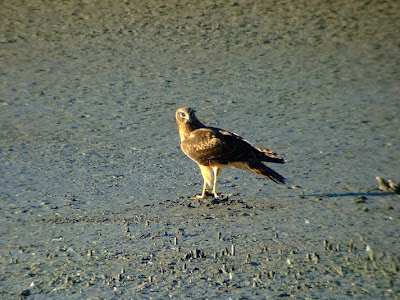


Disgusted at having missed Pectoral Sandpiper for the fourth time this fall at San Joaquin, I continued on to Upper Newport Bay. My spirits rose as I arrived at the north end of the bay. Shorebirds and ducks were everywhere. I sat down to scope the flocks spread over the bay, ignoring the curious glances from the gaudily-clad bikers streaming by. Most of the common duck species were well-represented, as well as shorebirds. I was happy to note a single male Eurasian Wigeon mixed in with the hoards of American Wigeons in the shallow water of the bay. Interestingly, I also saw a completely albino American Coot and a weird American Wigeon with a very white head - "without a tan".


I continued on, hoping to reach the beach before the lighting became problematic. As I rounded a bend, I was presented with a familiar sight at Upper Newport Bay: a group of binocular-bearing birders. I slowed myself to a halt with my slightly-defective brakes and inquired if they had "seen anything good".

"Oh, we're watching birds," came the reply.

"Yeah, me too," I said, nonchalantly raising my binoculars to study some ducks out in the bay.

"Well, there are two Clapper Rails down there," a man replied, waving a hand in the direction of some cord grass by the road.

I peered down, and sure enough, there was a pair of Clapper Rails lurking in the thick cord grass, occasionally popping out into the open. The group wandered away, and I watched as the rails foraged briefly on an open path of mud. One of them began bathing in the shallow water nearby.

I turned to a birder I knew who had stayed behind to watch the rails with me and asked "So, have you guys seen anything else interesting around here today?"

"Not really, though there's a Loggerhead Shrike out there," he casually responded.

Wow. Wait. Loggerhead Shrike?! This species has declined because of extensive habitat destruction throughout the county over the last few decades to the point that it is quite rare. I never expected to add it to my Bigby list, yet there was one perched on a snag far out in the marsh, scanning for small rodents or other tasty morsels. I thanked the birder, and spent several more minutes watching the rails and the shrike before continuing on.

I managed to reach Little Corona City Beach unscathed a short time afterwards, barely avoiding a couple idiots who almost ran me down. I began scoping from the top of the bluff, searching for Black Oystercatchers, loons, or interesting gulls. A friendly old lady, a local most likely searching for conversation, came up to me and when I explained I was "birdwatching" told me she pitied those poor blind pelicans, gesturing towards about a dozen Brown Pelicans loafing on the rocks below the overlook. Blind pelicans? I inquired. Yes, she said, don't they become blind from the cataracts they get from diving in the water? I stifled a laugh and told her that the pelicans could see perfectly well. After a few more minutes of chatting, she left and I set about the serious business of scoping the ocean for seabirds.

This got boring after a couple minutes (and no, I don't even have A.D.D.) - there were hardly any birds. A few Black-vented Shearwaters were doing what they do best, shearing the water, a mile or two offshore. The only other bird of interest was a single Red-throated Loon that flew by, a new species for my Bigby list. I descended to the beach, toting my scope on my shoulder and nibbling on my lunch as I hopped and slid around the slick rocks in search of Black Oystercatchers. I walked down the beach quite a ways, finding Black Turnstone, Ruddy Turnstone, Willet, Whimbrel, and Black-bellied Plover, but no oystercatchers. Huh, I thought to myself, I came all this way for a single lousy Red-throated Loon? Apparently so.

I began drifting home. I rewarded myself with a Coke and a candy bar (I enjoy eating healthy lunches when I go out for bike rides), and finished the rest of my lunch. I mostly ignored all the birds as I rode back around Upper Newport Bay, since I had already looked at them on the way and knew that they were all Marbled Godwits and Willets (well, mostly...). I debated stopping at San Joaquin Wildlife Sanctuary again, but decided to let Pectoral Sandpiper go without a fight. I did, however, swing by Mason Regional Park, where someone had seen a Clay-colored Sparrow a few days before. It was just about the worst time of day to be looking for passerines - they all seemed to be taking a siesta. I wearily pedaled home, arriving late in the afternoon with sore muscles, sunny cheeks, and an appetite the size of my bird list of the day. Oh yeah, the bird list. Without really trying, I tallied one hundred and twenty-eight species. Not bad for a day of biking - it beats my previous record by about ten. One hundred and forty is possible with a bit of route-tweaking. That will be for another day, however.