Pages

Showing posts with label vernal pool. Show all posts

Saturday, March 14, 2015

The amphibian exodus


Wood Frog (Lithobates sylvaticus)

Late last night, returning from a jam session with my friend Alex, I saw frogs like popcorn on the rainy roads. I even saw (and narrowly avoided squishing) a salamander army-crawling across the nature center driveway. And so I decided to go for a midnight amphibian hunt even though I craved sleep.

Such nights are ideal for finding frogs and salamanders. Amphibian movements are dictated by rain--their skin must remain moist, and some individuals traverse hundreds of meters of high ground to reach their breeding pools. Moving at night presumably ameliorates desiccation and lends security from predators.

They covet vernal pools, those ephemeral puddles that will dry by July. These temporary ponds cannot house fish and other aquatic predators, creating a safe nursery for amphibians. But, the amphibians can't waste their time--the pools will dry, and if the larvae cannot mature, they perish. Starting in late February and early March, the salamanders stage a sluggish exodus from their subterranean hovels to their ice-rimmed breeding pools.

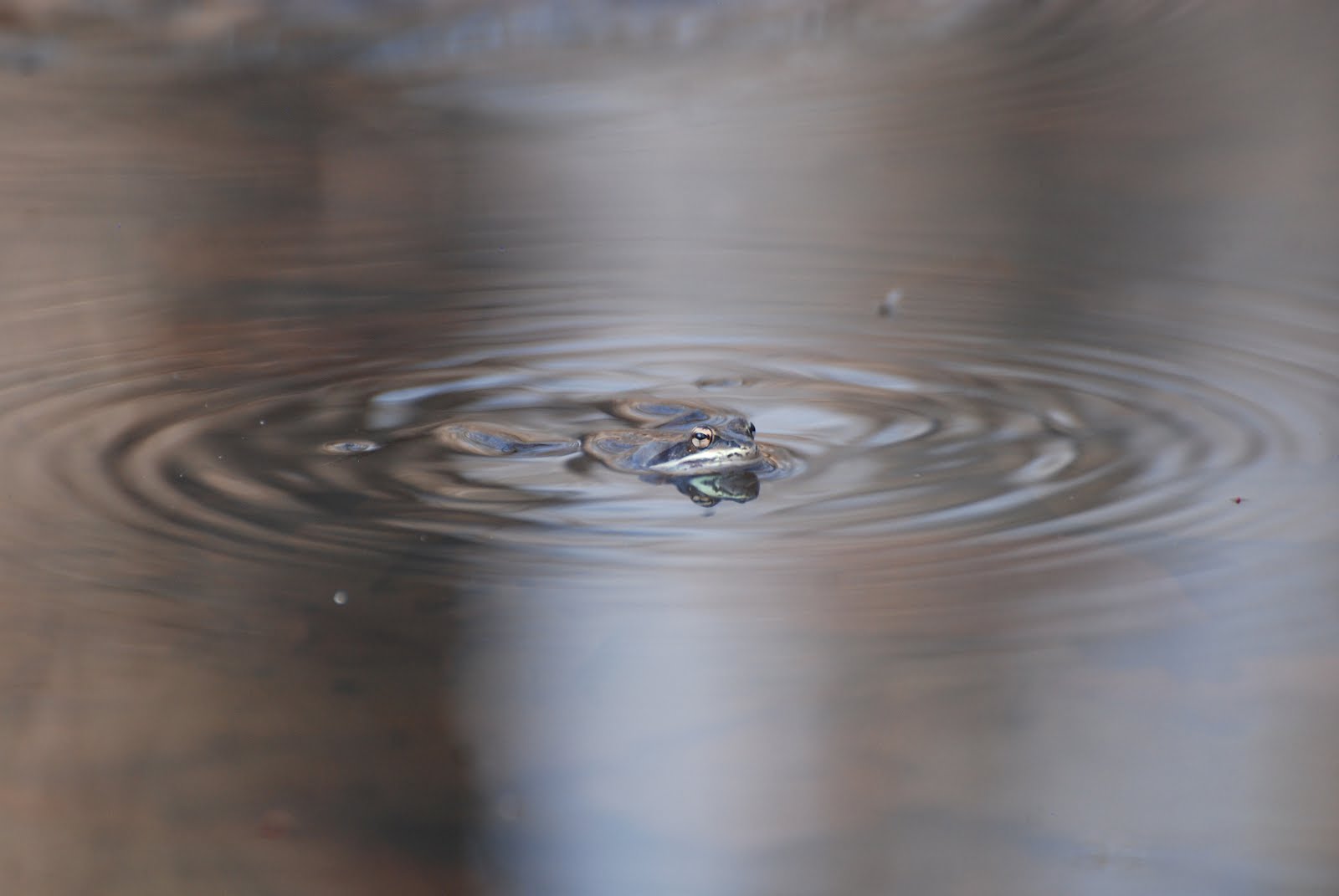
As I hiked through the persistent rain, I imagined seething masses of salamanders and cautiously planted each step to avoid pancaking any migrating amphibians. The scene at the first pool I visited was much less exciting than I had imagined--a few chilled Wood Frogs floated around, but nothing else. I had to search for ten minutes until I found my first Jefferson Salamander.


Jefferson Salamander (Ambystoma jeffersonianum)

I moved on to a second pool. This one throbbed with frog activity. I could hear the Spring Peepers from a quarter-mile away, and as I drew close, I could Wood Frogs gurgling the base line to the frog cacophony. The frogs, chilled and hormone-charged, were easy to catch.


Spring Peeper (Pseudacris crucifer)


Wood Frog (Lithobates sylvaticus). Crawling onto a sheet of ice isn't such a great decision when you are a poikilotherm!

No salamanders. I probed the shallow water with the beam of my headlamp, but the hunt was fruitless. Finally, out of desperation, I cast my net into the pool and dredged a three-foot section of the pool's bottom. To my astonishment, the net came up with a Spotted Salamander! I couldn't duplicate this feat despite casting the net a dozen more times.


Spotted Salamander (Ambystoma maculatum)

And finally, this evening, while seeking woodcocks at Shor Park, I came across this fearsome salamander that I cannot identify
.

Just kidding--it's a crayfish, of course. I decided to overcome my deep-seated fear of crustaceans and picked it up. I didn't even get pinched! I can highly recommend the experience. Don't be afraid.

Friday, March 16, 2012

Orgy at the Pool


An idyllic puddle in the woods, you may be thinking, just the perfect spot for a few minutes of meditation on an balmy spring evening. Think again.

This is actually a vernal pool, a polite term for a den of orgy. The shallow water roils with hormonally-charged frogs, croaking loudly enough to be heard a quarter-mile away. Perhaps not the most conducive spot for an evening of peaceful philosophizing, but a fascinating place nonetheless that deserves a visit.


The participants in this orgy are Wood Frogs, Lithobates sylvaticus. As their name implies, these small frogs are denizens of woodlands. Indeed, they have abandoned the water except for reproduction, which is explosive; after the first warm days of the spring, the entire population descends upon traditional breeding pools, and, after a few frantic days of calling, fighting, mating, and laying eggs, returns to dry ground for the remainder of the year.


A pool filled with several hundred calling male Wood Frogs is a scene not quickly forgotten. Their guttural croaking is reminiscent of a quacking duck. To get an idea of the experience, watch this video.


The males float around on the water, croaking and fighting among themselves. Paired sacs on the sides of their necks inflate as they call, and often they lunge through the water in pursuit of other frogs as they call.


Mating is a process of trial and error. The males grab every frog they can until they find a female. If another male is grasped, the assaulted male will squeal a "release" call to inform the other male of his mistake. As you can imagine, the pond water roils with the chaos.


Eventually, however, things work out and a male and female will mate. And, since I'm sure that you're as fascinated by frog sex as I am, I can't help but dive into the gory details. Almost everyone has seen frogs or toads mating in ponds, the male clinging for dear life to the back of the female. But did you know that frog fertilization is actually external? That's right--frog mating is a form of pseudocopulation known as amplexus. The male wraps his front legs around the female's body, assisted with special nuptial pads on his thumbs. As she lays the eggs, he squirts out the sperm, and so the next generation of frogs is conceived.


Wood Frogs are fascinating creatures. They are the most widely distributed frog in North America, ranging north of the Arctic circle. Such a northerly distribution requires extraordinary adaptations, and the Wood Frog's method of surviving the winter is truly fabulous: it freezes. It produces antifreeze, composed of glucose, which supports its cells while the water crystallizes. The brain is inactive; the heart stops beating.

Birds seem so boring in comparison!