Pages

Friday, June 15, 2012

Wildlife Manhandling


As the photo above indicates, I have recently spent time within the range of the rare Kirtland's Warbler. So rare is this creature that birders from all recesses of the globe make the pilgrimage to see this gray and yellow spirit of the Jack Pines, and since my girlfriend Alison gets paid to show people the Kirtland's, I too have made the pilgrimage, mostly to see her but also to see the warbler. In addition to seeing many a Kirtland's and several different subspecies of birder (Homo sapiens aviaphilosis), Alison and I explored and wandered and roamed and rambled and otherwise adventured, trying to find as many forms of life northern Michigan could offer up last weekend.


Quite accidentally I discovered a family of woodcock chicks at Hartwick Pines State Park. I had withdrawn into some shade while waiting for Alison to attend to business matters, and, becoming bored, investigated a plaintive whistle from the undergrowth. It sounded like a fledgling, but not the one I expected!

The majority of our adventures took place at a certain boggy flooding in eastern Crawford County. Masquerading as a lake, this flooding is only about four or five feet deep in its center, as we discovered once we made an exploratory expedition on inner tubes. But, surrounded by wonderful marshes, bogs, and streams, the "lake" is extremely secluded and teems with wildlife, particularly dragonflies. At times trashing through blueberry thickets, others wallowing among lily pads, and still others precariously venturing across beaver dams, we chased these toothed masters of the sky, waging war with net and camera lens.


The dragonflies were quality, too, not just the run of the mill Green Darners or Blue Dashers. I believe this one is an Ashy Clubtail (Gomphus lividus).


Some of the dragonflies supplicated us for peace by landing on our arms, shoulders, and even the rim of the net. Foremost among the dragonfly hippies were the Chalk-fronted Corporals (Ladona julia).


Frosted Whiteface (Leucorrhinia frigida)


Beaverpond Baskettail (Epitehca canis).


Hudsonian Whiteface (Leucorrhinia hudsonica).


Lilypad Clubtail (Arigomphus furcifer).


Racket-tailed Emerald (Dorocordulia libera).

After many steps through the swamp, our bared legs tired of the merciless tearing of the stiff branches. Seeking a clearer route, we retreated upland to the forest. We had not gone far when we were confronted  with a plaintive bleating sound. Tracking it through the dense underbrush, we found the living skeleton of a young fawn hobbling through the forest. Having neither gun nor knife with which to humanely kill it, we left it to wander and die of starvation. Yes, the deer would die, but its legacy would live on; its molecules would strengthen the muscles of some raccoon or fox. Bacteria would break down its hide and whatever the scavengers missed, the nutrients would sink into the soil, only to be taken up by some plant, which would then be cropped by another deer--perhaps the fawn's father, or a cousin. The circle of life would remain broken.


A mite traumatized, and perhaps poignantly reminded of our own mortality, we retreated from the woods and returned to the treacherous tussocks and mud wallows. Eventually, Alison hit upon a brilliant idea and began wading through the thigh-deep water, thereby circumnavigating the scratchy bushes and deadly sinkholes. It was here that the tables turned and the wildlife began manhandling us. Much to my horror, we discovered leeches attached to our legs! Snakes, spiders, ticks--I am not bothered by them--but leeches! I coated mine with toothpaste; the fluoride worked some deadly magic and exploded the vile creature, causing streams of swirled red and white liquid to dribble down my leg as I drove. I gritted my teeth and attempted to ignore the sensation.


Speaking of driving, I must conclude with the reason for this flooding's seclusion: it requires some beastly driving! The Stinkpot, my trusty Taurus, carried us down logging roads and even off roads to avoid fallen trees and other such obstacles.


Yes, there is much more to Kirtland's country than just Kirtland's Warblers. I eagerly anticipate the next pilgrimage!

Wednesday, May 23, 2012

Oh, Snap!


She was repulsive! Her head and neck, precisely the shape of a pregnant pickle, was studded with horny scales and festooned with two white slugs. Small and unblinking, her eyes oozed translucent scum. Her arms were heavy, wrinkled, and the color of moldy bread.

Looks like she just crawled out of a swamp, I couldn’t help but think.

Closer inspection corroborated my initial reaction; the girl on the gravel roadside was a Snapping Turtle. Entombed to her armpits in loose soil and gravel, she wearily rotated that grotesque neck and fixed me with a gaze of contempt. Fearful of the powerful jaw and not wishing to disturb her homemaking, I crouched several feet away, and she resolutely returned to filling in her nest hole with her powerful hind legs. Swipe! Each rake of those sharp curved claws sent a cascade of gravel into the nest hole.

Snappers seem more appropriately classified as junior dinosaurs or proto-dragons than relatives to the cute, quaint Painted and Box Turtles. The long, spiked tail and the jagged rear marginal scutes are the strongest suggestions of this hypothetical relation. Every time I wade in lakes, my brain must dismiss my recurring fear of stepping on one of these hideous monsters.

The growl of a pickup interrupted my reptilian meditations. It was one of those white Penn State physical plant trucks, the abundant acronyms emblazoned on its flanks lending it an air of jurisdiction. The truck jolted to a stop behind me; two guys popped out, both the sort you might expect to be roaming a state game area in central Pennsylvania—stocky, clad in sturdy boots and jeans, and chewing tobacco.

“Howday!” hailed the lead guy, his rural Pennsylvanian twang confirming my suspicions of his origins.

I returned his greeting by jerking my chin at the half submerged turtle and saying, “Big ‘un, isn’t she?”

“Yuppp,” he said, unclipping a grimy measuring tape from his belt. He fixed it behind the turtle’s head, stretched it back, and hollered, “Twelve and a half!” His stoic companion nodded in response.

He prodded her with the measuring tape. “Found seven of ‘em yesterday, ‘long the road. Coons already got one of the nests” Leaning over, he spat a brown jet over the snapper’s carapace and lifted up her tail. “Looks like she’s all done…c’mon, lemme help ya out.” He hauled her out of the hole and kicked it full of gravel and dirt.

“Ever eat’n one?” he asked.

“Nope…” I answered, taken aback.

“Yuppp…been awhile, but the meat’s white and tender.” The snapper, oblivious to the assistance, continued to gouge scrapes in the road. The fellow presented her with the tip of the measuring tape, but the turtle only glared at it.

 “She’s taired, mighty taired—prolly walked all night,” the silent companion piped up, his first contribution to the conversation.

“Yup—think I’ll give ‘er a ride back to the pond,” returned the first guy. He gingerly grabbed the snapper’s tail and hoisted her into the truck bed. “Weaaall, good talkin’ to you, we gotta turtle to deliver!” They climbed into their truck, executed a neat three-point turn, and rumbled off in the direction of the pond a half-mile distant.

As the truck climbed a hill, I could see the snapper sprawled in the bed. Smiling at the comical sight, I stamped the dirt over the nest more firmly and pondered the turtle’s feelings. Was she appreciative of the help? Did the indignity enrage her? Or is any such emotional analysis inappropriate, the turtle brain being purely instinctive and immune to emotion, a tabula rasa?

Whether or not turtles are capable of appreciating roadside assistance, next time you encounter an errant snapper, move her out of the road, but mind the claws and jaws!

Saturday, April 28, 2012

Amphibian Distractions


In order to irk any readers that may still exist, I will prolong the absence of birds in favor of frogs. My apologies--but amphibians are fascinating enough to merit attention, even if that means skimping on the birds. This sprite is a Spring Peeper. 

Ubiquitous, but sufficiently tiny and cryptically colored to avoid detection, Spring Peepers are always a treat to find. Their piercing cries echo from every corner of the preserve in the spring, but this is only the third or fourth I've actually laid eyes on this season. Finding this guy was a random stroke of fortune--I was kneeling on the forest floor of the preserve, dutifully yanking up garlic mustard plants (all a day in the office), when the peeper, startled, sprang from underneath the canopy of garlic mustard I was tussling with.


Finally, to satiate those who fail to appreciate amphibians, here is a shot of one of the most common birds in the woods at this moment, a Yellow-rumped Warbler. Though my life is dominated by papers and final projects at this point, it seems that nearly every day I see another first of the season--a Palm Warbler, then a Warbling Vireo, then a Spotted Sandpiper. May approaches, and the migrants are pouring northward!

Friday, March 16, 2012

Orgy at the Pool


An idyllic puddle in the woods, you may be thinking, just the perfect spot for a few minutes of meditation on an balmy spring evening. Think again.

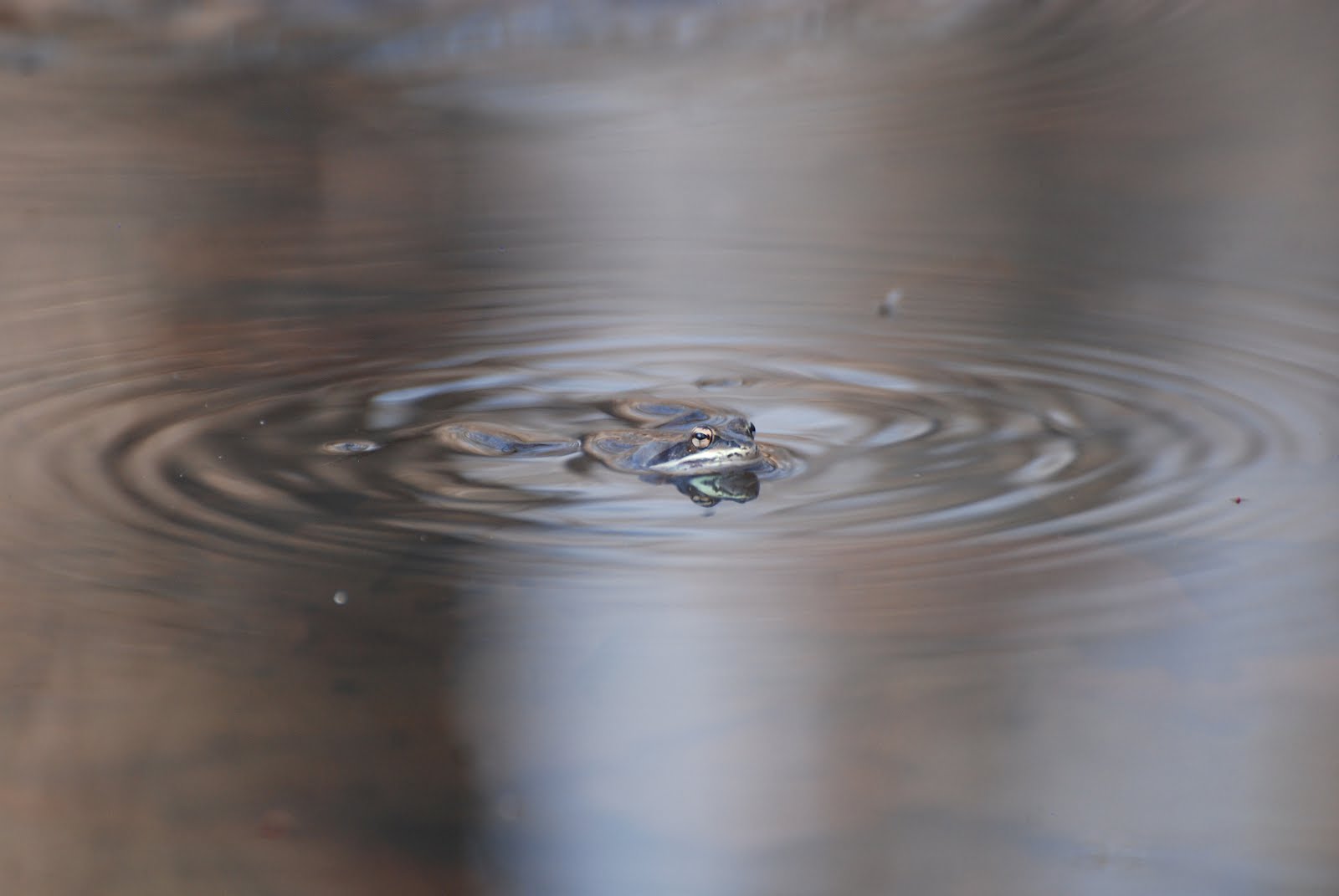
This is actually a vernal pool, a polite term for a den of orgy. The shallow water roils with hormonally-charged frogs, croaking loudly enough to be heard a quarter-mile away. Perhaps not the most conducive spot for an evening of peaceful philosophizing, but a fascinating place nonetheless that deserves a visit.


The participants in this orgy are Wood Frogs, Lithobates sylvaticus. As their name implies, these small frogs are denizens of woodlands. Indeed, they have abandoned the water except for reproduction, which is explosive; after the first warm days of the spring, the entire population descends upon traditional breeding pools, and, after a few frantic days of calling, fighting, mating, and laying eggs, returns to dry ground for the remainder of the year.


A pool filled with several hundred calling male Wood Frogs is a scene not quickly forgotten. Their guttural croaking is reminiscent of a quacking duck. To get an idea of the experience, watch this video.


The males float around on the water, croaking and fighting among themselves. Paired sacs on the sides of their necks inflate as they call, and often they lunge through the water in pursuit of other frogs as they call.


Mating is a process of trial and error. The males grab every frog they can until they find a female. If another male is grasped, the assaulted male will squeal a "release" call to inform the other male of his mistake. As you can imagine, the pond water roils with the chaos.


Eventually, however, things work out and a male and female will mate. And, since I'm sure that you're as fascinated by frog sex as I am, I can't help but dive into the gory details. Almost everyone has seen frogs or toads mating in ponds, the male clinging for dear life to the back of the female. But did you know that frog fertilization is actually external? That's right--frog mating is a form of pseudocopulation known as amplexus. The male wraps his front legs around the female's body, assisted with special nuptial pads on his thumbs. As she lays the eggs, he squirts out the sperm, and so the next generation of frogs is conceived.


Wood Frogs are fascinating creatures. They are the most widely distributed frog in North America, ranging north of the Arctic circle. Such a northerly distribution requires extraordinary adaptations, and the Wood Frog's method of surviving the winter is truly fabulous: it freezes. It produces antifreeze, composed of glucose, which supports its cells while the water crystallizes. The brain is inactive; the heart stops beating.

Birds seem so boring in comparison!

Monday, January 30, 2012

The Cost Effective Solution to Maximize Birding Potential


Financially impoverished birders have two options. The first is to never take birding trips; the other is to embark on bum adventures on minimal budgets. The latter is, of course, the superior option. A five-day break before my spring semester started provided a perfect time span for such a bum trip, so my girlfriend Alison and I headed north, to the Upper Peninsula.

The Bum Code of Birding has but three rules:

1. Never spend money on unnecessary luxuries (e.g., hotels, showers, food, etc).
2. Pay for necessities (bridge fares, parking fees, coffee) with scrounged change.
3. Avoid plans. Drift.

Follow the rules, and you will enjoy abundant success.


The eastern Upper Peninsula, in the vicinity of Sault St. Marie, is a popular destination for northern specialties in the winter. We wandered the area, finding birds like Bohemian Waxwings...


...Pine Grosbeaks...


...Pine Siskins...


...and Common Redpolls. All of these birds were at Dunbar Experimental Forest well south of the Sault. The feeders there teamed with hundreds of siskins and redpolls. Strange combinations of southern and northern birds--American Robin and Pine Grosbeak, Red-winged Blackbird and White-winged Crossbill--made things interesting.

A day of birding the Sault was plenty. The Sault style of birding--driving around country roads, occasionally pulling over to check out a shrike or Snow Bunting--appeals to neither Alison or me, so we moved westward, into the land of spruce and birch, to search for denizens of the boreal forest.


At Peshekee Grade, west of Marquette, we donned snowshoes and tramped through a couple feet of snow to look for Boreal Chickadees, Gray Jays, and Black-backed Woodpeckers. The line between walking and wallowing loses sharpness in snow of this depth--we both took our fair share of spills.


Ah, but it was worth it! The loss of a bit of dignity is certainly compensated by the sight of Boreal Chickadees, brown and raspy-sounding, clambering through the snowy spruces.


Our other targets, however, remained concealed in the frozen forest. The Gray Jays, however, were kind enough to find us the moment we began to eat lunch back at the car. They liked tortillas just fine but refused to eat Clif bars.


Many miles of hiking over the next couple days failed to produce our other quarry, the Black-backed Woodpecker. But, the remainder of our time was filled with adventure--the discovery of the most immaculate gas station bathroom in existence, the consumption of pasties that exceeded a pound in weight, and a brief jaunt "just to stretch the legs" that morphed into a ten mile hike at Pictured Rocks. I look forward to the next bum trip I will take. Where I will go and which birds I will see will remain unknown until the very moment of occurrence.

Wednesday, January 11, 2012

Winter Stewardship


No, it wasn't a dream! I really do have a job wandering around outside looking at birds! I worked another shift Monday morning and once again thoroughly enjoyed
myself.


The biggest surprise came early in the shift. While pishing at a flock of chickadees at the edge of the preserve, I noticed a midget of a bird, wings crackling with energy, bouncing around in the underbrush nearby. "Oh, cool, Golden-crowned Kinglet." It had been awhile since I'd seen one in the preserve. Suddenly, the bird, which I had not yet glassed, opened its bill and uttered a snappy jid-it, seemingly indignant I had mistaken him for his cousin. Yes, a Ruby-crowned--a bird worth ignoring in California, but, here in Michigan, an excellent bird for the winter.


Compared to October and November, when the skies are full of flyovers, the January skies are bleak and empty except for the resident Red-tails or geese winging over. It was a pleasant surprise, then, when this Northern Harrier cruised overhead. It was a new campus bird for me.


It was a chilly morning, temperatures lounging a few degrees above freezing. Too warm for snow, but plenty cold for frost and stiff fingers.


The preserve was a farm back in the olden days. Some of the clues to its history are subtle, like the uneven ground from the tilled fields, but others, like the skeleton of this old car, are blatant evidence of the past.


A would-be white landscape now masquerades as a different place, a place much farther to the south with scarce snow, maybe Tennessee. The dearth of snow this winter is frightening. The woods are brown and steel-gray instead of white. Here and there, however, scraps of color--lichens or rose hips--can be found.


Even if it's the "wrong" color, the preserve still an art gallery with innumerable exhibits. Some are only visible if you kneel in the leaf litter with a critical eye. Beetles may belong to the phyla Arthropoda, but their sculpture outdoes that of some human artists I have seen.

What surprises are waiting in the woods for next time?

Sunday, January 8, 2012

The Preserve


After a series of boring, frustrating jobs, I've finally landed one I genuinely enjoy: preserve steward in Calvin's ecosystem preserve. My responsibilities? Walk the trails, greet visitors, clear fallen branches, pick up litter, and, oh, watch birds.


It is tempting to surmise that frigid (well, actually, it's been extraordinarily warm this winter) woods are lifeless, but three hours of roaming through them will convince you otherwise. Bird numbers and diversity were low, as would be expected, but my wanderings produced a couple goodies, including a Northern Shrike and a Great Horned Owl. I had packed only my wide-angle lens, so the shrike in this photo may or may not be identifiable.


The woods really are beautiful this time of year. I will cherish the privilege of being paid to wander through them.