Pages

Thursday, July 19, 2012

Boring Annotated List for Historical Purposes


My apologies for such a dreary post--just a list--but perhaps in a few years this inventory will provide a few minutes of diversion. This is the list of birds that my girlfriend Alison and I observed on our float down the Manistee River from the Deward area to No. 19 Rd near Mesick from July 4-7, 2012. 

Canada Goose—small numbers, mostly in scattered family groups incapacitated by molt. One such group that I splashed with my paddle scrambled up the bank in panic, including one bird that flapped and flopped and fell backwards.
Wood Duck—seen daily, but very sparsely. Probably fewer than 15 for the entire float.
Mallard—common. Many family groups, ranging from fully grown “ducklings” to very young, recently hatched broods.
Hooded Merganser—not seen until the second day of the trip, but after that very common on the lower part of the river (past Sharon Bridge).
Common Merganser—few; about a dozen total
Horned Grebe—surely the most unexpected bird of the float, a singleton paddling around the river several miles upstream from the CCC bridge. A Horned Grebe on such a small shallow river would be unusual at any season, but this species is unprecedented in this part of the world in the middle of the summer. It was in full alternate plumage and appeared to be in good health.


Great Blue Heron—surprisingly scarce, only three or four.
Green Heron—a handful (half a dozen?) scattered along the entire length of the river. Most of them demonstrated their well-deserved nickname “Fly-up-the-Creek” by flushing ahead of the canoe many times before finally turning around.
Turkey Vulture—two or three
Osprey—one, on the final day of the float
Bald Eagle—five, all adults. On the second day, I chucked a rubber duckie that I had found in some jetsam at a perched bird, much to its indignation.
Sharp-shinned Hawk—one bombed across the river on our second day
Red-shouldered Hawk—a few (5) heard calling from along the river
Broad-winged Hawk—half a dozen or so
Spotted Sandpiper—common. We spotted three young families near the end of our float on the third day. We paused for the first family and captured one of the very young chicks running around at the edge of the river.

Solitary Sandpiper--one, an early migrant, flushed from a mudbank on our second day.
American Woodcock—two. Oddly, one was still displaying at the CCC campground. One flew by our canoe at dusk in the last mile or two of the last day.
Herring Gull—Alison saw one; I remain skeptical
Mourning Dove—No comment
Yellow-billed Cuckoo—one, on the last day.
Black-billed Cuckoo—one calling in the middle of the night at the CCC campground.
Great Horned Owl—a fledgling begging around midnight on the first day (i.e., night) of the float near the headwaters.
Barred Owl—three families, the first one seen and photographed shortly downstream from the CCC campground on the second day.


Common Nighthawk—a few heard at dusk most days. A large group seen flycatching high over the river in the late afternoon of the second day.
Eastern Whip-poor-will—heard every night, with impressive numbers (at least a dozen) heard in the few miles we floated on the first night. We even spotlighted one perched in a pine at the river’s edge.
Ruby-throated Hummingbird—only a few.
Belted Kingfisher—extremely common. At least seventy or eighty seen over the course of the trip. We noted several nests farther down on the last two days of the float in the high sandy banks in that area.
Red-headed Woodpecker—Alison saw one during our dinner break on the second day; several miles later we both heard one.
Red-bellied Woodpecker—two or three in the last quarter of the trip.
Yellow-bellied Sapsucker—abundant. At evening on the second day, we saw one perched on a telephone pole drumming on a metal casing, seeming to gloat over its superior volume.
Downy Woodpecker—uh-huh
Hairy Woodpecker—yeah
Northern Flicker—common
Pileated Woodpecker—surprisingly scarce; only a couple heard during the entire trip
Eastern Wood-Pewee—very common
Least Flycatcher—a single singing bird just downstream from the CCC bridge
Eastern Phoebe—modest numbers, particularly around bridges and cabins
Great Crested Flycatcher—fairly common; perhaps 10 or 12 a day.
Eastern Kingbird—small numbers. Most numerous on the first day.
Yellow-throated Vireo—a single singing bird on the second day.
Blue-headed Vireo—singing birds were fairly common, particularly around Red Pine plantations
Red-eyed Vireo—irritatingly abundant
Blue Jay--common 
American Crow—just a couple heard low down on the last day
Common Raven—heard every day, but sparsely enough that every single one was enjoyed and appreciated.
Northern Rough-winged Swallow—small numbers in the last quarter of the float where there were sandy banks for them to nest in.
Tree Swallow—only a few, nearly all in the upper reaches of the float.
Black-capped Chickadee--around
Tufted Titmouse—one or two pretty far downstream on the second day in an area with lots of deciduous trees.
Red-breasted Nuthatch—common wherever there were conifers (i.e., most of the float)
White-breasted Nuthatch—present the whole way
Brown Creeper—scattered small numbers (perhaps 10 total), particularly in areas with lots of spruce
House Wren—mostly limited to areas that had lots of cabins
Winter Wren—we heard singing birds every day, but in small numbers—perhaps twenty total?
Golden-crowned Kinglet—a few
Eastern Bluebird—one or two in the upper reaches
Veery—two singing birds
Hermit Thrush—common
Wood Thrush—just a couple
American Robin--everywhere
Gray Catbird—not everywhere; only two for the whole float
Brown Thrasher—one chipping fella on the morning of the third day
European Starling—a flyover flock of about fifty birds late in the evening on the second day ruined our fantasy that we would go the entire trip without seeing any.
Cedar Waxwing--lots
Ovenbird--omnipresent
Louisiana Waterthrush—a chipping bird far downstream on the third day was almost surely this species judging from the habitat.
Northern Waterthrush—about two singing birds mid-way through the float
Black-and-white Warbler—scattered singing birds along the whole float; perhaps 8 or 9 total?
Nashville Warbler—very common, particularly in the upper reaches of the river.
Mourning Warbler—fairly common, particularly in the lower reaches of the river; we heard probably fifteen on the third day.
Common Yellowthroat--common
American Redstart—common on the second and third days of the float
Cape May Warbler—three singing males; two in the upper reaches on the first day (Kalkaska County) and one near the end of the float (Wexford County)
Northern Parula—one singing bird on the second day
Blackburnian Warbler—three or four singing birds, mostly in the upper reaches.
Pine Warbler—abundant wherever pines were, which was along most of the float


Yellow-rumped Warbler—common; several dozen total
Black-throated Green Warbler—very common, though oddly we heard none north of M-72.
Canada Warbler—just one or two singing birds
Chipping Sparrow—we had two subspecies of Chipping Sparrows…cabin lawn Chipping Sparrows, and Red Pine plantation Chipping Sparrows
Field Sparrow—two singing birds
Song Sparrow—everywhere, kinda
Lincoln’s Sparrow—only one, a singing bird in a boggy area north of M-72
Swamp Sparrow—small numbers of singing birds in marshy areas
White-throated Sparrow—lots of peabodiers, mostly in boggy areas (e.g., between 612 and M-72)
Dark-eyed Junco—a few here and there
Scarlet Tanager—very common in the last third or so of the float. Prior to that, very sparse.
Northern Cardinal—small numbers (about five) near the end of the float
Rose-breasted Grosbeak—surprisingly uncommon, at least in comparison with the Ausable…maybe ten or a dozen a day
Indigo Bunting--yuppp
Red-winged Blackbird— common around marshy areas…otherwise, not common
Common Grackle—abundant on the first day (especially north of M-72), but very few/none seen later
Brown-headed Cowbird--some
Baltimore Oriole—here and there
Purple Finch—small numbers (20 total), including birds visiting cabin feeders
Pine Siskin—one or two flyovers heard
American Goldfinch—very common
Evening Grosbeak—small numbers (8ish?)

Monday, July 16, 2012

130 Miles of Peanut Butter


PREFACE

Like so many adventures, this one was prefaced by a lesser escapade. It was a lovely warm May afternoon, and Alison and I were on a casual float down the Au Sable River. We were having such a blast that, together, simultaneously, we formulated a scheme to canoe the Au Sable River from Grayling to Lake Huron.

While roaring down the road in the pickup belonging to Kevin, the Jack Pine savage from whom we had borrowed the canoe, we described our plan, to which Kevin shook his head and boomed, “Oh, no, no, you don’t want to do that. Too many dams! You want to float the Manistee!” He slapped his knee and laughed his jovial guffaw that is impossible to impersonate or even describe, apart from the fact that it is fatally infectious. We wheezed and chortled and tried not to choke on the musty aroma of Kevin’s kleptomaniac Golden Retriever that saturates the truck’s interior.

So it was that nearly two months later in the middle of the night Alison and I found ourselves wresting an old barge of a canoe off the roof of my Taurus, which was dwarfed by the craft that would bear us one hundred and thirty miles from the Manistee’s headwaters to Mesick.


FOOD

Provisions for trip had to satisfy two criteria: cost and packability. Student budgets cannot accommodate frills; we sought cheap, high-calorie food that wouldn’t spoil (we had neither cooler nor stove). At the beginning of the trip, I made an inventory of our supplies:

  • Peanut butter
  • Nutella
  • Cashews
  • Raisins
  • Apples
  • Granola
  • Hershey’s dark chocolate kisses
  • Tortillas
  • Michigan cherries (3 pounds)


On the second night, however, we were so tired that we crashed before properly securing our food. At four-thirty in the morning we awoke to the terrible sounds of rummaging and ripping plastic. Fortunately, the tortillas were the only item that the coons pilfered (though they did try to roll the peanut butter jar off into the woods), so we jokingly dined on seven-course meals the rest of the trip:

“What’s the first course?”
“Raisins—wait, no, we need to break up all the nuts. Cashews.”

We would munch on handfuls on cashews, then chew on raisins, then dip our fingers into the peanut butter and nutella, crunch through an apple, lap grains of granola from our cupped hands, and finally finish up with a dessert of dark chocolate. For every meal we would switch up the order of the courses to fool our palates and avoid dietary boredom.

WATER

Alison recently became the proud new parent of a pump-system water filter. Her central duty of the trip (oh yeah, other than steering the canoe…) was to pump our water. Within minutes, cool water traveled from the river down the esophagus. Near the end of the float, when the river became murky from accumulating silt and junk, pumping the water was a greater workout than paddling the canoe. Neither of us was stricken with giardia, so the contraption did its job.


THERMOREGULATION

A river, particularly one like the Manistee with abundant deep pools, is a good place to be on ninety-degree day. We paddled all day, striving to cover dozens of miles every day, but that did not prevent us from making frequent swimming stops—and by “frequent”, I mean four or five dips per afternoon. The most memorable hole was shaded by an overhanging Basswood that we could clamber up and leap from to bombard the water fifteen feet below.

THE JEFF CORWIN EXPERIENCE

It was late afternoon, our minds fixated on dinner and a restful campsite, when suddenly Alison cried, “There goes a Green Snake across the river!” Sure enough, ahead the snake wriggled across the river like a swimming cattail leaf. We dug in our paddles to intercept it. The snake was aimed for a large cedar overhanging the river; we “landed” (or rather, crashed) into the cedar just before the snake reached it. The serpent hesitated, debating whether to turn around or make a bolt for the cedar. In this moment of indecision, I bailed, expecting the river to be easily waded. Instead, I sank into neck-deep water. Half-swimming, half-running, I made a lunge for the reptile. My right hand brushed against it; I locked my fingers, bellowed “GOT IT!”, and fell backwards into the water. It was my first Green Snake. We caressed it for several minutes before releasing it into the cedar, which it climbed with remarkable agility for a creature lacking limbs. 


ODES

Ambitious mileage is not conducive to dragonfly hunting, but during our few brief stops we managed to find several species of river odes. 

I think this is a Cobra Clubtail (Gomphus vastus).


The Dragonhunter (Hagenius brevistylus), the biggest, baddest, and burliest of all the clubtails. This monster patrols the river, abdomen kinked, and exudes the cockiness of a totalitarian dictator, striking fear into the thoraxes of the lesser dragonflies.


On the opposite side of the spectrum lies the delicate and comely Violet Dancer (Argia fumipennis).

Clubtails and their kin can be infuriatingly difficult to observe and capture as they perpetually patrol an inch above the river's surface. I took many a futile swing. Finally, this Boreal Snaketail (Ophiogomphus colubrinus) was foolish enough to alight on my wrist. I trapped him by hand, but even when I released him, he was reluctant to leave.

THE END

We somehow underestimated the mileage to our take-out spot on the final day of the float, and as the evening progressed, so did our anxiety as bend after bend failed to reveal our end point. The shadows grew long, fused, and the sun slipped away; as the light faded we dug harder and harder with our paddles, reaching forward and leaning back with every stroke. The canoe streaked forward with impressive velocity. It was getting dark; Alison urgently wanted to get back, but I didn't want to capsize in the dark and drown. As the colors faded into grays and blacks, we paused to discuss stopping for the night--but just then, a parked car appeared behind some bushes, and then we realized that the outhouse looked familiar, and finally behind another bush we spotted Alison's car. Relieved, we ran the canoe aground on the boat ramp, tottered out, and hugged each other with shaking arms. We had made it--barely! 

Saturday, June 16, 2012

Sweet Scratches


Blackberries, my brothers and I used to call them as we crawled through the brambles after the luscious jewels. I halt my lope, crack open my lab notebook, and scrawl, “Rubus occidentalis, fruit beginning to ripen, flowering done.” Clapping the notebook shut and continuing in the direction of the field house for lunch, I make a mental note to return to the berry patch and pick some of the Black Raspberries.
            Plants—perhaps not my first choice for summer study, but here I am anyway, paid to wander swamp and swale, forest and field, identifying and tracking the flowering of the plants at Flat Iron Lake Preserve. I am learning to walk like a botanist, to take slow steps, to scrutinize the forest floor, to prepare species for the plant press. Each day, I find myself drawn deeper and deeper into the world of plants, identifying cinquefoils, sow thistles, and yes—raspberries.
            Rousing myself from a lazy afternoon nap, I don jeans, hoping the denim will be sufficiently rugged to withstand the briers. Shoes, a metal bowl, and I’m out the door, sauntering down the hill toward the gargantuan patch, so large that it wouldn’t fit in a three-car garage. The blackberries—no, Black Raspberries, I remind myself—hang in alluring clumps, ripe and juicy for the taking.
            As I plunge into the patch, I also dive into a deep pool of memories, a pool nearly stagnant and forgotten but still lingering in the attic of my mind. Suddenly I see the face of my older brother Keith, flushed with excitement as we embark on a foraging expedition. Crudely woven baskets hang from our wrists—twisted together just for this purpose, to hold and transport our juicy treasure. Now I see the stern face of my other brother Ian, chastising me for taking berries to eat on my Corn Flakes—berries reserved for the pie, he said. Oh, but the pies took so many blackberries! The spindly patch next to our driveway only produced a handful at a time, so occasionally we would mount our bikes and search for other bramble thickets.
            Here I am a decade later, facing a thicket bearing more berries than I can possibly eat. Neither of my brothers is here to help, either; we are scattered across three separate states, united but twice or thrice a year. During these uncommon times, we remember the old times, laughing over our archaeological exploits in the backyard, the snowball fights, the vendetta we held against our playful old neighbor. I begin plucking the berries, one at a time, just the way I used to.
            One at a time. Greediness loses berries. Gently grasp each between the thumb and the index finger; the berry will loosen with minimal effort. The most luscious prizes always hang in back of the patch, where the canes are thickest and the thorns sharpest. Push the leaves aside, lift the runners, crouch and crane your neck; dozens of blackberries may be hiding within reach beneath the canopy. Step cautiously—the runners are stubborn and can easily trip a clumsy foot. The one thing I have forgotten is a long-sleeved shirt, but I conclude that lacerated arms are a small price to pay for the delicious rewards.
            The nasal scolding of a catbird returns my thoughts to the present. Whose dinner am I pilfering? Catbirds eat fruit; perhaps he was protesting my foraging efforts. Cedar Waxwings, robins—plenty of other birds might snack on these same berries, but I can’t remember having ever seen them feasting on them. Abundant sun-shriveled berries attested that the birds and other creatures could not keep pace with such a cornucopia.
            As I wallowed deeper into the thicket, trying to reach those sweetest morsels, a sprite of a damselfly flutters up weakly, coming to rest on a drooping leaf. I lean forward, glimpsing green exclamation points on the top of the black thorax. Fragile Forktails certainly do not eat berries, but this plant provides him too with dinner, only in the form of aphids rather than berries. Aphids—delicious! I scrutinize my growing heap of black gold and spot an aphid hopping about merrily! Suddenly, I bolstered my resolve to thoroughly wash my fruit and even contemplated refraining from eating them straight off the bush. That notion, however, violates tradition; I pop a particularly fat berry into my mouth and crush it against the roof of my mouth, savoring the streams of sweet juice cascading across my palate. If there was an aphid on that berry, it only supplemented the flavor!


            An hour of picking produced a couple pounds of berries. What to do? If only Ian were here now; we could bake pie after pie and still have leftovers to eat with our cereal! I survey the pantry’s scant provisions: oatmeal, flour, brown sugar, butter—enough for blackberry crisp, anyway! Into the oven it went, emerging half an hour later, sizzling and emitting a smell that would transform the taste buds of an insectivorous forktail into bubbling saliva springs! I devour serving after serving and am astonished to discover it all gone. I glance at the empty pan, rub my slightly bulging belly, and peer out the window at the patch that promises thousands more berries and many more pans of blackberry crisp.

Friday, June 15, 2012

Wildlife Manhandling


As the photo above indicates, I have recently spent time within the range of the rare Kirtland's Warbler. So rare is this creature that birders from all recesses of the globe make the pilgrimage to see this gray and yellow spirit of the Jack Pines, and since my girlfriend Alison gets paid to show people the Kirtland's, I too have made the pilgrimage, mostly to see her but also to see the warbler. In addition to seeing many a Kirtland's and several different subspecies of birder (Homo sapiens aviaphilosis), Alison and I explored and wandered and roamed and rambled and otherwise adventured, trying to find as many forms of life northern Michigan could offer up last weekend.


Quite accidentally I discovered a family of woodcock chicks at Hartwick Pines State Park. I had withdrawn into some shade while waiting for Alison to attend to business matters, and, becoming bored, investigated a plaintive whistle from the undergrowth. It sounded like a fledgling, but not the one I expected!

The majority of our adventures took place at a certain boggy flooding in eastern Crawford County. Masquerading as a lake, this flooding is only about four or five feet deep in its center, as we discovered once we made an exploratory expedition on inner tubes. But, surrounded by wonderful marshes, bogs, and streams, the "lake" is extremely secluded and teems with wildlife, particularly dragonflies. At times trashing through blueberry thickets, others wallowing among lily pads, and still others precariously venturing across beaver dams, we chased these toothed masters of the sky, waging war with net and camera lens.


The dragonflies were quality, too, not just the run of the mill Green Darners or Blue Dashers. I believe this one is an Ashy Clubtail (Gomphus lividus).


Some of the dragonflies supplicated us for peace by landing on our arms, shoulders, and even the rim of the net. Foremost among the dragonfly hippies were the Chalk-fronted Corporals (Ladona julia).


Frosted Whiteface (Leucorrhinia frigida)


Beaverpond Baskettail (Epitehca canis).


Hudsonian Whiteface (Leucorrhinia hudsonica).


Lilypad Clubtail (Arigomphus furcifer).


Racket-tailed Emerald (Dorocordulia libera).

After many steps through the swamp, our bared legs tired of the merciless tearing of the stiff branches. Seeking a clearer route, we retreated upland to the forest. We had not gone far when we were confronted  with a plaintive bleating sound. Tracking it through the dense underbrush, we found the living skeleton of a young fawn hobbling through the forest. Having neither gun nor knife with which to humanely kill it, we left it to wander and die of starvation. Yes, the deer would die, but its legacy would live on; its molecules would strengthen the muscles of some raccoon or fox. Bacteria would break down its hide and whatever the scavengers missed, the nutrients would sink into the soil, only to be taken up by some plant, which would then be cropped by another deer--perhaps the fawn's father, or a cousin. The circle of life would remain broken.


A mite traumatized, and perhaps poignantly reminded of our own mortality, we retreated from the woods and returned to the treacherous tussocks and mud wallows. Eventually, Alison hit upon a brilliant idea and began wading through the thigh-deep water, thereby circumnavigating the scratchy bushes and deadly sinkholes. It was here that the tables turned and the wildlife began manhandling us. Much to my horror, we discovered leeches attached to our legs! Snakes, spiders, ticks--I am not bothered by them--but leeches! I coated mine with toothpaste; the fluoride worked some deadly magic and exploded the vile creature, causing streams of swirled red and white liquid to dribble down my leg as I drove. I gritted my teeth and attempted to ignore the sensation.


Speaking of driving, I must conclude with the reason for this flooding's seclusion: it requires some beastly driving! The Stinkpot, my trusty Taurus, carried us down logging roads and even off roads to avoid fallen trees and other such obstacles.


Yes, there is much more to Kirtland's country than just Kirtland's Warblers. I eagerly anticipate the next pilgrimage!

Wednesday, May 23, 2012

Oh, Snap!


She was repulsive! Her head and neck, precisely the shape of a pregnant pickle, was studded with horny scales and festooned with two white slugs. Small and unblinking, her eyes oozed translucent scum. Her arms were heavy, wrinkled, and the color of moldy bread.

Looks like she just crawled out of a swamp, I couldn’t help but think.

Closer inspection corroborated my initial reaction; the girl on the gravel roadside was a Snapping Turtle. Entombed to her armpits in loose soil and gravel, she wearily rotated that grotesque neck and fixed me with a gaze of contempt. Fearful of the powerful jaw and not wishing to disturb her homemaking, I crouched several feet away, and she resolutely returned to filling in her nest hole with her powerful hind legs. Swipe! Each rake of those sharp curved claws sent a cascade of gravel into the nest hole.

Snappers seem more appropriately classified as junior dinosaurs or proto-dragons than relatives to the cute, quaint Painted and Box Turtles. The long, spiked tail and the jagged rear marginal scutes are the strongest suggestions of this hypothetical relation. Every time I wade in lakes, my brain must dismiss my recurring fear of stepping on one of these hideous monsters.

The growl of a pickup interrupted my reptilian meditations. It was one of those white Penn State physical plant trucks, the abundant acronyms emblazoned on its flanks lending it an air of jurisdiction. The truck jolted to a stop behind me; two guys popped out, both the sort you might expect to be roaming a state game area in central Pennsylvania—stocky, clad in sturdy boots and jeans, and chewing tobacco.

“Howday!” hailed the lead guy, his rural Pennsylvanian twang confirming my suspicions of his origins.

I returned his greeting by jerking my chin at the half submerged turtle and saying, “Big ‘un, isn’t she?”

“Yuppp,” he said, unclipping a grimy measuring tape from his belt. He fixed it behind the turtle’s head, stretched it back, and hollered, “Twelve and a half!” His stoic companion nodded in response.

He prodded her with the measuring tape. “Found seven of ‘em yesterday, ‘long the road. Coons already got one of the nests” Leaning over, he spat a brown jet over the snapper’s carapace and lifted up her tail. “Looks like she’s all done…c’mon, lemme help ya out.” He hauled her out of the hole and kicked it full of gravel and dirt.

“Ever eat’n one?” he asked.

“Nope…” I answered, taken aback.

“Yuppp…been awhile, but the meat’s white and tender.” The snapper, oblivious to the assistance, continued to gouge scrapes in the road. The fellow presented her with the tip of the measuring tape, but the turtle only glared at it.

 “She’s taired, mighty taired—prolly walked all night,” the silent companion piped up, his first contribution to the conversation.

“Yup—think I’ll give ‘er a ride back to the pond,” returned the first guy. He gingerly grabbed the snapper’s tail and hoisted her into the truck bed. “Weaaall, good talkin’ to you, we gotta turtle to deliver!” They climbed into their truck, executed a neat three-point turn, and rumbled off in the direction of the pond a half-mile distant.

As the truck climbed a hill, I could see the snapper sprawled in the bed. Smiling at the comical sight, I stamped the dirt over the nest more firmly and pondered the turtle’s feelings. Was she appreciative of the help? Did the indignity enrage her? Or is any such emotional analysis inappropriate, the turtle brain being purely instinctive and immune to emotion, a tabula rasa?

Whether or not turtles are capable of appreciating roadside assistance, next time you encounter an errant snapper, move her out of the road, but mind the claws and jaws!

Saturday, April 28, 2012

Amphibian Distractions


In order to irk any readers that may still exist, I will prolong the absence of birds in favor of frogs. My apologies--but amphibians are fascinating enough to merit attention, even if that means skimping on the birds. This sprite is a Spring Peeper. 

Ubiquitous, but sufficiently tiny and cryptically colored to avoid detection, Spring Peepers are always a treat to find. Their piercing cries echo from every corner of the preserve in the spring, but this is only the third or fourth I've actually laid eyes on this season. Finding this guy was a random stroke of fortune--I was kneeling on the forest floor of the preserve, dutifully yanking up garlic mustard plants (all a day in the office), when the peeper, startled, sprang from underneath the canopy of garlic mustard I was tussling with.


Finally, to satiate those who fail to appreciate amphibians, here is a shot of one of the most common birds in the woods at this moment, a Yellow-rumped Warbler. Though my life is dominated by papers and final projects at this point, it seems that nearly every day I see another first of the season--a Palm Warbler, then a Warbling Vireo, then a Spotted Sandpiper. May approaches, and the migrants are pouring northward!

Friday, March 16, 2012

Orgy at the Pool


An idyllic puddle in the woods, you may be thinking, just the perfect spot for a few minutes of meditation on an balmy spring evening. Think again.

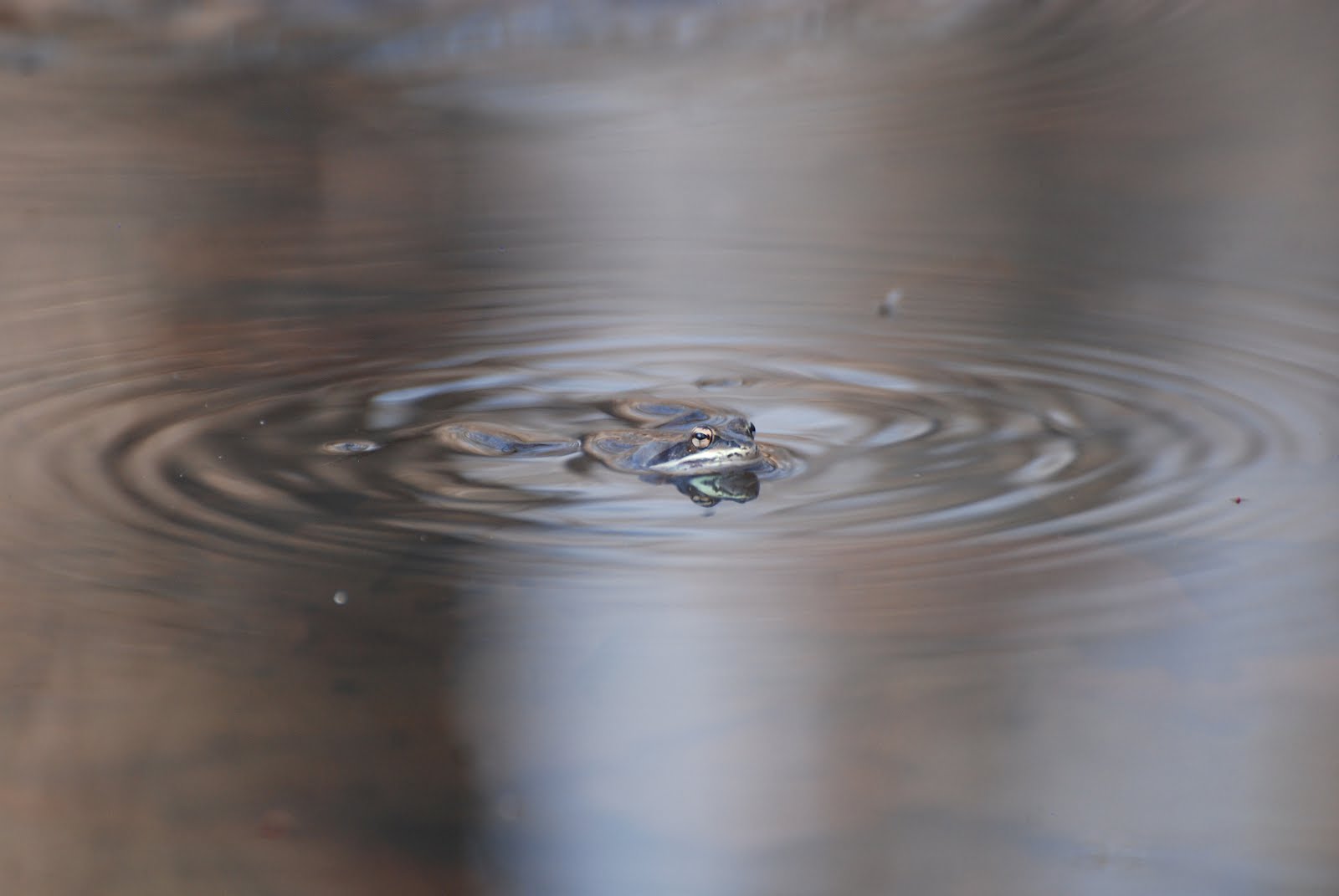
This is actually a vernal pool, a polite term for a den of orgy. The shallow water roils with hormonally-charged frogs, croaking loudly enough to be heard a quarter-mile away. Perhaps not the most conducive spot for an evening of peaceful philosophizing, but a fascinating place nonetheless that deserves a visit.


The participants in this orgy are Wood Frogs, Lithobates sylvaticus. As their name implies, these small frogs are denizens of woodlands. Indeed, they have abandoned the water except for reproduction, which is explosive; after the first warm days of the spring, the entire population descends upon traditional breeding pools, and, after a few frantic days of calling, fighting, mating, and laying eggs, returns to dry ground for the remainder of the year.


A pool filled with several hundred calling male Wood Frogs is a scene not quickly forgotten. Their guttural croaking is reminiscent of a quacking duck. To get an idea of the experience, watch this video.


The males float around on the water, croaking and fighting among themselves. Paired sacs on the sides of their necks inflate as they call, and often they lunge through the water in pursuit of other frogs as they call.


Mating is a process of trial and error. The males grab every frog they can until they find a female. If another male is grasped, the assaulted male will squeal a "release" call to inform the other male of his mistake. As you can imagine, the pond water roils with the chaos.


Eventually, however, things work out and a male and female will mate. And, since I'm sure that you're as fascinated by frog sex as I am, I can't help but dive into the gory details. Almost everyone has seen frogs or toads mating in ponds, the male clinging for dear life to the back of the female. But did you know that frog fertilization is actually external? That's right--frog mating is a form of pseudocopulation known as amplexus. The male wraps his front legs around the female's body, assisted with special nuptial pads on his thumbs. As she lays the eggs, he squirts out the sperm, and so the next generation of frogs is conceived.


Wood Frogs are fascinating creatures. They are the most widely distributed frog in North America, ranging north of the Arctic circle. Such a northerly distribution requires extraordinary adaptations, and the Wood Frog's method of surviving the winter is truly fabulous: it freezes. It produces antifreeze, composed of glucose, which supports its cells while the water crystallizes. The brain is inactive; the heart stops beating.

Birds seem so boring in comparison!