Pages

Saturday, June 13, 2009

Home from Yosemite


The lack of blog posts in the past week has not been caused by my usual chronic laziness, but because I was on a family vacation in the Sierra Nevadas with my family. We spent most of our time in Yosemite National Park, but we also visited Mono Lake and Sequoia National Park. I had a lot of fun, even though it wasn't an intense birding trip, and saw a lot of interesting birds, animals, and scenery.

I took many photos, perhaps too many (>800), even though my camera had a close brush with death after a brief dip in a chilly creek. I will work on posting some of them this next week, though I plan to avoid lengthy chronicles of the trip; I don't have the time to write about every detail.

Briefly, some of the highlights of the trip are as follows: seeing four life birds (Calliope Hummingbird, Brewer's Sparrow, Sage Thrasher, and Black-billed Magpie); observing bears, marmots, deer, and various other mammals; having a close encounter with a Great Gray Owl; and rafting on the Merced River. Keep your eyes open for more photos and brief stories from the trip.

Friday, June 5, 2009

The Mountains


Last weekend my dad and I took a trip up to the San Jacinto Mountains, an interesting mountain range a couple hours due east of us in Riverside County. In the San Jacintos it is easy to find species that are difficult or impossible to find in Orange County, including White-headed Woodpecker, Tricolored Blackbird, and Steller's Jay. It is also very fun to camp and hike in the wilderness among great birds and another animals.

Dad and I left Thursday evening and made it up to Boulder Basin Campground by nine O'clock. Boulder Basin is a very remote place; a bumpy five-mile drive up a rough mountain road is required to reach it. After setting up camp we wandered through the deserted campground, listening for owls (the campground is supposedly a good spot for Flammulated), but all was silent. Finally, as we were drifting off to sleep in our tent, a Western Screech-Owl called several times. I found this very unusual, since the campground is 7,800 feet above sea level and is vegetated mostly with pine trees. Screech-Owls aren't supposed to be up so high, but it was, and who knows why.

We awoke early Friday morning to the twittering of Violet-green Swallows swooping around the campground. As the morning slowly dawned, other species added their voices: Olive-sided Flycatcher, Western Wood-Pewee, Western Tanager, White-headed Woodpecker, and others. We birded around the campground for a few minutes, finding a few new species, including Dusky Flycatcher, Black-chinned Sparrow, Hairy Woodpecker, and Pygmy Nuthatch.


Once we were all packed up, we bounced a few miles further up Black Mountain Road. A lookout a mile or two past Boulder Basin offers stupendous views. A family of Rock Wrens was jumping around the large rocks here, and the warbled song of a Cassin's Finch drifted up from the forest below.


We took a quick walk around the parking area for the Fuller Ridge Trail, about 8,000 feet above sea level. Here, both Fox Sparrows (of the "Thick-billed" group) and Green-tailed Towhees sang their similar melodious tunes from the tops of stunted trees.


The road doesn't really go anywhere past the Fuller Ridge Trailhead, so we turned around and descended the mountain. After a rough ride, we made it back to the unbelievably smooth highway. We searched a couple creeks for dippers, but once again we failed to find any. By the time we reached Idyllwild it was roughly lunch time, so we stopped and had lunch at Idyllwild County Park nature center. The feeders there were unfilled and desolate. After finishing up, we drove around to the other side of the park and set up camp in the campground. I quickly made friends with the local Steller's Jays with a bag of peanuts I had brought for just that purpose. The brazen birds would land on the other end of the picnic table and steal peanuts right out of the bag!


Later in the afternoon, we took a drive down the highway to Lake Hemet and the Garner Valley. Lake Hemet, usually devoid of birds, produced a Bald Eagle, a Clark's Grebe, and some Mallards and Coots. Sinister thunderheads rolled in, rumbling and sprinkling a bit of rain but not doing anything serious.


The alarm clock sounded early on Saturday morning, around five-thirty. We were planning to hike up the Devil's Slide Trail above Idyllwild, and an early start is a good way to beat the heat of the day. The first mile or two of the hike is rather dull bird-wise, but offers nice views of Suicide Rock (top of this post.) After a couple hours of hiking, however, we found some interesting birds, including Red-breasted Sapsucker, Mountain Quail, Green-tailed Towhee, Brown Creeper, and Hermit Warbler. When we reached Saddle Junction, two and a half miles and 1,500 feet above the parking lot, we decided to take the trail to Tahquitz Peak. Unfortunately, this trail simply disappeared after a quarter-mile, so after wandering around in the woods for awhile, we turned around and headed back to Saddle Junction. We took the Pacific Crest Trail about a mile farther up, probably to about 9,000 feet above sea level. The views from up there were spectacular, to say the least!


It was a long and hot hike, hard on the knees, back down to the parking lot. We got back to our campsite in the early afternoon. Some Western Gray Squirrels and Acorn Woodpeckers had joined the Steller's Jays in snitching peanuts.


After a lovely grilled dinner of kebabs, squash, and eggplant, we drove around a bit in the evening. One some random back roads above Idyllwild we were treated to a beautiful sunset.


I wanted to stay up late and look for Flammulated Owls at Humber Park above Idyllwild, but my dad didn't like this idea so we went to bed early instead. I'll get Flammulated once I don't have the stupid 11 p.m. - 5 a.m. curfew on my driver's license. We ended up getting up ridiculously early Sunday morning; we were packed up and out of the campground by six thirty. After the mandatory coffee stop, we took Highway 74 down through the Garner Valley to Santa Rosa Mountain. On the way, we saw a Bobcat dead in the road (and yes, we did actually stop so I could get a photo!)


We also stopped for a colony of Tricolored Blackbirds in a little swampy area near Lake Hemet. There were dozens of them in this tiny marsh right next to the highway, and many more in the surrounding fields. They look just like Red-winged Blackbirds, save for the white stripe below the red instead of a pale yellow stripe. Their call notes are also noticeably different - more of a choking sound than anything else.


Our trip up Santa Rosa Mountain turned out to be a bust, since the road was way to rough for our minivan to handle. Gr. I can't wait to get a Jeep or something that is actually capable of going up dirt roads. In the half-mile or so we went up the road we saw Black-chinned Sparrow, Blue-gray Gnatcatcher, and Black-headed Grosbeak. After our failed excursion, we headed back through the Garner Valley and drove random roads until we came across a flock of Pinyon Jays. After finally finding them we couldn't seem to get away from them, as we heard several other flocks. We took a drive up a not-so-rough dirt road, and, in some hills above the valley, I picked out an unfamiliar sparrow song. I had a hunch that it was a Sage Sparrow, and after listening to it on my iPod I was sure that's what it was. I eventually spotted it singing from the top of a bush close to the road and obtained some crummy photos.


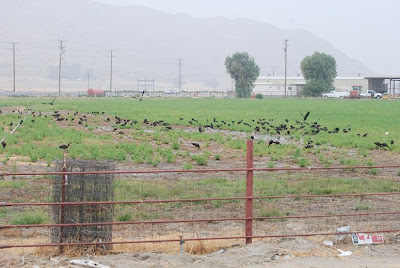
At this point there wasn't much left to do in the mountains, so we cruised down Highway 74, past Hemet (another coffee stop was in order), and on to San Jacinto Wildlife Area. On our way there we came across a field filled with White-faced Ibis, along with four Cattle Egrets. I've never seen so many Ibis in one place before!


We took a quick spin through the auto tour loop at San Jacinto Wildlife Area. As I expected, there wasn't too much there, since most of the ducks and shorebirds have departed. However, I was surprised to find at least twenty Yellow-headed Blackbirds in one pond, the males displaying and giving their raucous calls. I also heard a Virginia Rail here.


We birded for a few more minutes at San Jacinto Wildlife Area before heading home. In a few days of camping we had accumulated a truly incredible amount of dust and muck on the car, inside and out. We quickly got the car unloaded and washed, much to my mom's relief (the van technically is her car, after all.) We saw some great birds (no lifers, but seven new species for Riverside County) and had a fun time hiking, grilling, birding, and adventuring. I can't wait to do it again.

Monday, June 1, 2009

Dragonfly Lifer #9: Blue-eyed Darner


I'll readily admit that my favorite dragonflies are the big bruisers, more specifically the darners. These monster-dragonflies terrorize all smaller insects, other dragonflies included. Until Friday, I had only positively identified the Common Green Darner, which is, as its name implies, very common.

I took a quick walk up to the neighborhood lake midday on Friday to see if any dragonflies were out and about. I quickly spotted an unfamiliar darner cruising around low over the water's surface. It landed a few times before disappearing, allowing me to snap a couple poor photos. When I arrived home I identified it as a Blue-eyed Darner (Aeshna multicolor.) I was glad to find another species of darner! It is a stunning dragonfly, and my crummy photo cannot do it justice.

The lake was fairly humming with dragonfly on Friday. Nearly invisible forktails weakly fluttered within centimeters of the water, a few Flame Skimmers cruised around, a couple female Green Darners laid eggs in floating vegetation, and several Blue Dashers hawked insects from perches. I was able to improve on my Blue Dasher photos.


Keep an eye open for my report of the trip my dad and I took to the San Jacinto Mountains this past weekend. I'll try to have photos up by next weekend, when I will be leaving with my family for Yosemite.

Saturday, May 23, 2009

Rescue


As I was driving home from my art class on Tuesday night around nine-thirty, I noticed an odd lump in the gutter of our street. As I drove closer, a head popped up - a Mallard head! A female Mallard and a whole brood of ducklings were huddled in the gutter a couple houses down my street. Streets generally aren't good places for duck families, since they are sitting ducks (no pun intended) for coyotes, house cats, and crazy drivers. I pulled into our driveway and enlisted the help of my mom and brother for a rescue mission. We quickly walked down the street, armed with flashlights and a cat carrier.

The plan was simple: round up the ducklings, toss them into the carrier, and then transport them into the garage where they would spend the night safe from predators. I've heard of other people transporting ducklings and having the female follow them, so I figured she'd stroll right into the garage after us.

It took only a few minutes to catch all the ducklings - nine of them. The fuzzy little devils could scramble around very swiftly, but we were faster. We loaded them up in the cat carrier and moved them to the garage. The female followed, waddling around and nervously quacking.

Ducks apparently are not accustomed to being shut up in a garage, as it took a few minutes for the female to settle down. The ducklings all clustered around their mother and the family huddled in a clump for the night. We turned off the lights and bade them goodnight.

Our cat usually sleeps in the garage, so we had to find a spot for him to spend the night. I let him spend the night in my room. This was a mistake. He is apparently only capable of sleeping for a couple hours at a time, since he occasionally would walk around, meow, and knock stuff off my desk. Needless to say, I will never let him sleep in my room again.

In the morning I woke up bright and early, opened the garage door, and shooed the ducks out. They waddled into the yard and disappeared while I went inside to eat breakfast. Later we saw a female Mallard with three ducklings on the lake. It's entirely possible this was the same family, grossly reduced in size by various predators, but we'll never know. At least we could provide the ducklings a safe haven their first night.

First Batch of Michigan Photos (Belated)

I am sure many reading this blog have been wondering the past month where my report of my trip to Michigan in April was. Well, I have excuses. I've been working hard the past month finishing up my AP classes, and I simply haven't gotten around to posting photos or a report. So, here is the first batch of my photos from the trip, over a month late. I don't have the time to write a full report, but here are some photos with short descriptions.


The main purpose of the trip was to investigate two colleges in western Michigan, Hope College in Holland and Calvin College in Grand Rapids. I took this American Robin photo in Holland. I didn't like Hope College, or Holland for that matter; my mom and I saw few birds during the few minutes we poked around the area (though, of course, that was not the only reason I didn't like the college or the city.) However, robins were abundant. Robins are relatively uncommon in California, so it was a treat to see and hear them in masses again.


This unspectacular photo shows a very nifty bird. The Midwest experienced a massive invasion of White-winged Crossbills this winter. I angrily read of crossbills being seen within a couple miles of my old house. I had never seen one before. And, just as luck would have it, almost all of the birds had departed by the time I arrived in Michigan. A handful were sticking around Brighton State Recreation Area in Livingston County, so we stopped there on our way from Grand Rapids to Detroit. I easily located several quietly feeding in the tops of some tamarack trees. After a few minutes they became restless and took off. I was happy to see at least a few after reading about hordes of them all winter. Interestingly, in several years I saw an extraordinary number of rare birds within a few miles of the crossbill spot: White-eared Hummingbird, Rufous Hummingbird, Bullock's Oriole, Spotted Towhee, and Townsend's Solitaire. These may sound ho-hum to the seasoned Californian, but to Michiganders these species are rare and exotic.


A rare sight in California, but a common one in the Midwest: a sprawling corn field. One of the days we were in Michigan I went birding with a few old friends of mine, including my mentor Karl Overman. We made the long drive to Mercer County, Ohio, to chase a flock of Smith's Longspurs that had been reported from this field. It's a good three and a half hours of driving to get there; fortunately, we easily found the birds. Another life bird for me, but unfortunately the birds were not cooperative for photographs.


This photo shows a meadowlark, more specifically a Western Meadowlark. Now, a Western Meadowlark is not a big deal in California, but in Ohio it is. The day I went birding with Karl and several other birders we also made a short detour to see it. A state bird for me.


Our vanload of birders also hit Oak Openings Metropark, a beautiful park west of Toledo. Oak Openings is one of my favorite spots for spring and summer birding. Several species breed there that are extremely difficult to find elsewhere in Ohio, including Lark Sparrow, Summer Tanager, and Blue Grosbeak. I photographed this White-breasted Nuthatch at the nature center feeders.


Another visitor to the feeders at Oak Openings was this cute little Red Squirrel. We don't get these guys in Southern California, so it was nice to see them again. I used to spend countless hours attempting to keep them off my bird feeders in Michigan.


Another interesting sighting at Oak Openings was this beautiful Blue Racer. We were walking along a road, seeing Red-headed Woodpeckers, Field Sparrows, Eastern Bluebirds, and others, when I looked down and nearly stepped on this snake.


We couldn't bird northwestern Ohio without a stop at Crane Creek. This legendary migration hotspot located on the shore of Lake Erie is an incredible spot for seeing warblers and other migrants in the spring. Unfortunately, I was a few weeks early for the big rush. In fact, birding was quite dull along the boardwalk. However, I enjoyed strolling along the boardwalk I've stalked so many times. I visited Crane Creek every year, starting in 2000 (almost a decade ago!) The most interesting bird we saw was an Eastern Screech-Owl that popped out of a tree cavity when Karl began imitating its whistled call.


Common Grackles, though obnoxiously common in Michigan and Ohio, are truly beautiful to behold when the sun strikes them. This one was rummaging through the leaf litter at Crane Creek. Pretty handsome guy, eh?

That's all for now. Hopefully I'll get some more up soon. It was an excellent trip. I liked Calvin College in Grand Rapids, so we will be going back in the fall to take a second look. It was also great to go birding again in Michigan and Ohio and see old friends.

Sunday, May 17, 2009

The Shifting Seasons


As the year passes by, new Bigby birds become more and more difficult to root out. It is easy to add a few dozen new species the first few times out in a year, but after that you are lucky if you tally half a dozen with an all-day ride. I rode over forty miles today and managed to dig out only four new Bigby birds. That’s over ten miles for each bird.

I haven’t taken a long bike ride since late February, so I knew I would at least score a couple easy birds. My main targets for the day were Grasshopper Sparrow and Least Tern. The tern I could get any time all summer long, as this species frequents San Joaquin Wildlife Sanctuary and Upper Newport Bay. Grasshopper Sparrows are easy enough to find along Shady Canyon on the far side of University California Irvine, but it is a five-mile side trip up a large hill. As a result, I drag my rear end up there once a year, and once I have heard them I gleefully coast down the hill with Grasshopper Sparrow on my list.

I decided to leave early, around six fifteen, so I would make it down to Shady Canyon while the sparrows were still singing. Once I arrived at Shady Canyon, I immediately heard the Grasshopper Sparrows – two of them – buzzing away from the grassy slopes above the road. Great. I puttered around for a few more minutes before turning around and heading to San Joaquin. See you next year, sparrows.

The Least Terns at San Joaquin Wildlife Sanctuary also posed no problem. I easily found several flying around the first few ponds. While watching the terns, I noticed a Bonaparte’s Gull paddling around Pond C. Somewhat surprisingly, this was also a new Bigby bird for me (number two hundred, in fact!)


I wandered around San Joaquin for a couple hours, finding nothing extraordinary. All the neat winter birds – ducks and shorebirds – are gone, and I found very few migrants. However, there was a lot of breeding activity. Perhaps the most obvious were the American Avocets. The fluffy babies were prancing around the ponds, ignoring their shouting parents who were attempting to herd them around.


The most interesting nesting activity was happening on the Campus Dr. bridge over the San Diego Creek. Hundreds of Cliff Swallow nests line the sides of the bridge, and swarms of the swallows were fluttering around making a racket. It is very entertaining to stand below the bridge and drink in the spectacle: swallows poking their heads out of the nest holes, others gathering mud to be added on to the nests, and still others just flying around seemingly randomly.


In the late morning I decided to take a spin around Upper Newport to look for Elegant Terns. I had no luck with the Elegant Terns, and had very few birds overall. Only a few rather cruddy-looking shorebirds were around, probably second-years oversummering. All the ducks were gone. There were hundreds of Black Skimmers hanging around the nesting island at the north end of the bay, along with Forster’s and Least Terns. I gave up and headed towards home without finding any new Bigby birds.

While I was biking from Shady Canyon to San Joaquin earlier in the morning, I made a great discovery. Instead of taking the long way back through Mason Regional Park, I cut across from Culver on Campus. There, within a quarter mile of San Joaquin, I found an In-N-Out Burger restaurant. As I was biking from Upper Newport Bay, I was hungry, but I didn’t really feel like eating a squished peanut butter and jelly sandwich. I took the short detour to In-N-Out. As I looked over the menu (it isn’t hard to choose at In-N-Out, since there are only a handful of options), I pulled out my wallet and was horrified to find that I had only three dollars. Three bucks isn’t enough for a combo, but a burger and a small drink are only a few cents short of three dollars. Unfortunately, I had forgotten about a little thing called sales tax. Turns out I was fourteen cents short. Thankfully, the guy at the register let me off the hook and gave me $3.14 of food for $3.00.

After wolfing down my burger I headed for home. However, that plan changed when I last-minute decided to make a quick stop at Mason Regional Park. I’m glad I did. The park had decent numbers of migrants, which was nice to see after a couple weeks of absolutely dismal migration. The only new Bigby bird I found was Hermit Warbler (which I had actually been getting worried about), but I saw lots of Wilson’s, Townsend’s, Orange-crowned, and Yellow Warblers, along with Western Tanager, Black-headed Grosbeak, and Warbling Vireo.

I finally tore myself away from Mason and shot homeward. I kept my cruising speed around sixteen miles per hour and managed to get up the long hill on Jamboree Road without stopping. When I reached home, I was tired, dirty, and sunburned, but I had four new Bigby birds under my belt. These four new ones pushed my Bigby list up to two hundred and one. Here are a few more photos from the day.


Sunday, May 10, 2009

Dragonfly Lifers #7-8

I know I haven't posted about birds for awhile - after all, this is OCBirding, not OCDragonflying. However, I simply haven't had the time to sit down and write about the few birds I've managed to see recently in quick breaks of studying for my dreaded AP exams. In the last week I've found two more dragonfly lifers, bringing my list up to eight.

On Friday I took a quick jaunt down along the Yellowthroat Creek in my neighborhood. Spring migration has been really slow recently, so I focused on dragonflies. I didn't find many, but one of the few I found was a lifer: Flame Skimmer (Libellula saturata.) Now I know that I've seen plenty of these before, but the list starts from scratch. It's a common species throughout California, and if you live within their range you've probably noticed them as well. They are big, brilliant red-orange dragonflies that grab your attention.


I found number eight yesterday at Starr Ranch. I was there to assist with the MAPS bird banding program, but kept an eye out for dragonflies as we tromped along the creek to check nets. We had a great day, catching lots of birds. Some of the more interesting ones were Lazuli Bunting, Black-headed Grosbeak, Costa's Hummingbird, Black Phoebe, White-breasted Nuthatch, and Rufous-crowned Sparrow.

Back to dragonflies. The creek that runs through the banding area is a good spot for dragonflies. As we were furling the nets in the early afternoon, I noticed a brilliant red dragonfly perched low over the water near one of the nets. At first glance this one resembles another Flame Skimmer, but it is a much smaller and less bulky species. The abdomen in particular is longer and thinner than a Flame Skimmer.

There aren't many other dragonflies that are completely red like this one. It is a Cardinal Meadowhawk (Sympetrum illotum.) It is one handsome dragonfly. I've probably seen them before, but perhaps not.


Hopefully I'll have more time to write about birds later. I'll be completely done with AP exams on Friday, which should free up my schedule greatly.