Pages

Showing posts with label dragonflies. Show all posts

Saturday, August 21, 2010

Two Seas


My meager savings account is devoted to exactly two things: textbooks (bleh) and pelagic trips. I hoard the paltry amount of money that I occasionally manage to scrounge up, only to blow most of it on pricey pelagic trips. Worth it? Check out that photo.

I really wanted to squeeze in one more pelagic trip before I move to landlocked Michigan. My comrade Tim Snieder also wanted to venture out on the high seas before he returned to Ontario, so we decided to fulfill our destinies and booked spots on the two-day pelagic out of San Diego last week.

It takes a different breed of birder to do pelagic trips. First, resistance to seasickness is helpful. I score well in this category; I've felt the slightest queasiness on only a couple of trips. Second, the pelagic birder must endure hours of boredom. Huh?

I won't lie. Pelagic trips are boring. Hours can stretch between sightings of interesting birds. On this trip, another of my young birder friends Kenny and I amused ourselves by keeping hourly lists of birds. The lowest number of species we tallied in an hour was three. We thought it was pretty funny that we were entertaining ourselves on a birding trip by birding.

Fortunately, every trip has its moments of excitement. Like when a Skua wings by...


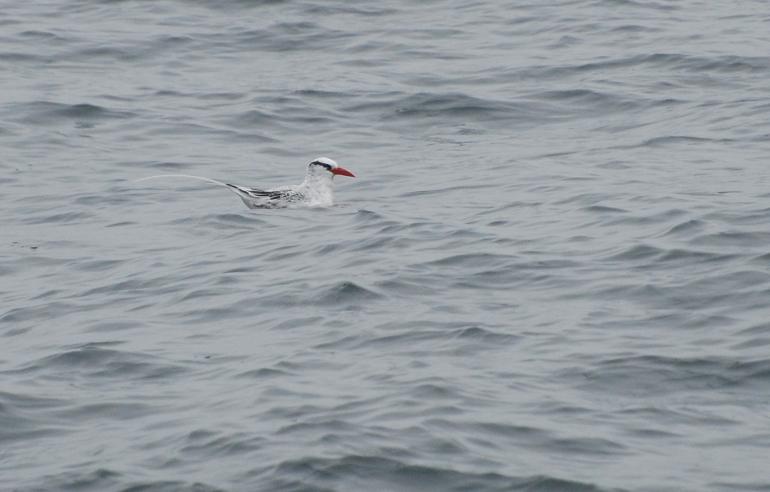
Or when the leaders start bellowing "TROPICBIRD" over the intercom, sparking a mass-awakening of birder-zombies from the legions of camp chairs in the stern (sitting after hours of standing on a pitching deck is highly tempting, but it invariably leads to sleep.)


Birds aren't the only attraction of pelagic trips. Whales, seals, and fish compete with jaegers, shearwaters, and storm-petrels for attention. On this trip, we were treated to thirty-six Baird's Beaked-Whales, two Blue Whales, numerous Mola-Mola, Guadalupe Fur-Seals, and Pacific White-Sided Dolphins. It was a truly unforgettable experience that I will remember for the rest of my life.


(Incidentally, if that previous line sounded exceptionally corny, excellent perception! It's a direct quote from...ehhh, I'd better protect his reputation.)


Even the "boring" pelagic birds (like this gaggle of Pink-footed Shearwaters) are always fun to watch simply because they are only seen when you venture offshore.

Our journey did not end when we disembarked. Tim and I decided to drive east and bird a second sea: the Salton. The only hitch occurred when we couldn't find a grocery store to purchase food and drink to sustain us through the ordeal of birding the Salton. Eventually, we found a little Mexican market and stocked up on orange juice, cheese, and pineapple. We did not leave without filling a bag to the brim with warm Mexican sweetbread, which we mercilessly devoured as we sped eastward.

Actually, there was a second hitch: border patrol. We were the victims of a small amount of crap from a couple border patrol officers simply because they found out Tim is Canadian. 'Nuff said.

These minor mishaps could not prevent us from reaching the sea. I had spent the entire two-hour drive warning Tim of the ferocity of the heat, but he was still shocked by the dense wall of stinky heat that hit us as soon as we were vomited out of the air-conditioned bowels of the loyal Subaru. "They say pelagics are the final frontier of birding," he muttered as he slathered on sunscreen. "But I think THIS is the final frontier."


The Salton Sea would be nowhere near as famous among birders if Yellow-footed Gulls hadn't decided to randomly invade from Mexico and hang out at the sea in the summer. The Salton Sea is the only spot in the country where they occur. Tim easily ticked his first ones while the car was still moving. We celebrated by slaughtering the unfortunate pineapple and gobbling it down in one sitting. For the next hour, my mouth burned and I felt sick to my stomach.

And it wasn't even that good of a pineapple.


We endured the heat (at least, we like to think we did...Tim entered a state of dormancy at several points) and the pineapple's revenge, finding lots of other great birds. Wood Stork, Ruff, Gull-billed Tern, Black Tern, Lucy's Warbler, and Gila Woodpecker, to be precise. Dragonflies were also abundant. I finally saw my lusted-after Roseate Skimmer for the first time, and even photographed it before Tim promptly murdered it in cold blood.


While searching for the phantom Pyrrhuloxia in Brawley, we almost tripped over this beastly-looking dragonfly. It wasn't a clubtail (as I had hoped), but a White-belted Ringtail.


It was with relief that we realized it was getting dark and that we could leave for home. The air was still hotter than a grilled cheese sandwich fresh off the skillet; temperatures remained in the triple digits well after nightfall. After another very long drive, we were back at my house, coated in grease, sweat, and mud, and a bit dehydrated as well.

Heck, I think birding either sea takes a different breed!

Thursday, August 20, 2009

Stunning Skimmers


If your memory is good, you may recall my confusion concerning two very similar species of dragonflies, Flame and Neon Skimmers. I coincidentally found my first Neon Skimmer just a day or two after posting photos of a skimmer I believed was a Neon Skimmer, but was actually a Flame Skimmer. Well, I thought I had already learned how to distinguish the two species, but today I was lucky enough to learn more about these two species by seeing both… within inches of each other!

I was searching for dragonflies along the lushly vegetated creek at Santiago Oaks Regional Park this afternoon when I spotted two brilliant reddish-orange dragonflies perched on the same stick near the stream. Inspection revealed one to be a Flame Skimmer, and the other a Neon Skimmer! Direct comparison of the two species allowed me to discover more identification techniques for these two dragonflies.

The most dependable difference between the two species is the extent of orange on the wings. Flame Skimmers have orange covering more than half of their wings, while Neon Skimmers show only a small amount of orange at the base of their wings. This is clearly evident in the photos. Another reliable identification characteristic is the color of the abdomen. Flame Skimmers appear bright enough to the uninitiated, but Neon Skimmers really knock your socks off. Their abdomens glow! Neon Skimmers appear much redder than Flame Skimmers.


In addition to these two classic field marks, I noticed a couple subtle differences between the two species when seen together. First of all, the Neon Skimmer had a slightly shorter and thicker abdomen than the Flame Skimmer. Second, the Flame Skimmer appeared to have slightly longer wings than the Neon Skimmer. Of course, these characteristics would be very difficult to ascertain on solitary skimmers, but when seen together, they might be helpful.

Oh, I forgot to mention which skimmer was which in the photos. I’ll let you figure it out.

Saturday, August 8, 2009

Dragonfly LIfers 14-16


I've gotten three life dragonflies in the past week, but before I write about those I need to back up and retract that Neon Skimmer from earlier in the week. I wasn't entirely sure about it, and sure enough several people contacted me to set me straight: it was actually a Flame Skimmer. However, I'm not taking Neon Skimmer off my list; on Thursday, I found several genuine Neon Skimmers (Libellula croceipennis) at Santiago Oaks Regional Park. In the photo at the top of this post and the next photo note the limited amount of orange in the wings and the retina-searing red abdomen. Not a bad-looking dragonfly!


I scored another life dragonfly at Santiago Oaks on Thursday, thankfully one that is easily identified. While hiking along one of the trails, I was buzzed by a very elegant blackish dragonfly with a bold white spot on its abdomen - a Pale-faced Clubskimmer (Brechmorhoga mendax)! Unfortunately, it was devilishly uncooperative for photos and this poor photo does not give this beautiful insect justice.


The dragonflies were so absorbing that I barely noticed the birds. Actually, that's mostly a lie, since it was midday and the birds were not very active anyway. The only decent bird photo I got was of this ragged Hutton's Vireo.


My second "life" dragonfly was none too exciting, since I've seen this species hundreds of times before. However, I'd never photographed it, so when I came across this Black Saddlebags (Tramea lacerata) patrolling the neighborhood lake, I spent quite a bit of time attempting to photograph this fast-flying insect. I made a few clumsy attempts to catch it but only succeeded in making a fool of myself.


Here's a second photo that shows the black "saddlebags" on the wings better.


This morning I went for a ride up Saddleback (the highest peak in the Santa Ana Mountains) with my dad and Bob Scrimger. I was surprised to find lots of darners flying around up near the peak, far from any water. Like the previous two species, it was a great challenge to photograph them in flight. I finally succeeded, and after a bit of research I am fairly confident this is a California Darner (Aeshna californica.)


Although we weren't doing any hard-core birding, we saw a few interesting birds, including Phainopepla, Mountain Chickadee, Western Wood-Pewee, Black-throated Gray Warbler, and others. The views were spectacular along Main Divide Road and on top of the peak. Looking south from the peak, we were treated to fine views of Starr Ranch and the overlapping hills of the southern Santa Anas.


Turning approximately 135º and looking northeast, we could see the distant San Gabriel, San Bernardino, and San Jacinto Mountains with the lower Santa Anas in the foreground.


We rewarded ourselves for surviving the bumpy trip down the mountain with an excellent lunch at the quaint Silverado Cafe (highly recommended!) It was a pleasant morning, with some good birds, excellent views, and my first California Darners.

So, it was a productive week for dragonflies. I snagged three lifers (four, actually, counting Neon Skimmer.) Hopefully more will come; I'm hoping to have twenty species on my list by the end of the summer!

Monday, August 3, 2009

Dragonfly Lifers #12-13


My pursuit of new dragonflies has been pushed to the back burner during the last few works while I was working at camp, but I've scored two new species recently. I'd better hustle out searching for dragonflies in the next few weeks before they start to disappear!

The first one is a bit graphic. I'd noticed dozens of small damselflies flitting about the neighborhood lake, and narrowed them down to Bluet sp. To positively identify them, I collected one and looked at the tip of its terminal abdomen appendage under a microscope. I was able to positively identify it as a Tule Bluet (Enallagma carunculatum.)


This afternoon, while photographing dragonflies at the neighborhood lake, I came across this skimmer. I assumed it was a Flame Skimmer at first, but after photographing it and looking it up in my field guide I believe it is actually the very similar Neon Skimmer (Libellula croceipennis.) The lack of dark brown streaks on the wings and the brilliant reddish orange abdomen seem good for this species.


I was also able to drastically improve on my photos of Red-tailed Pennant (Brachymesia furcata.) One has been hanging out at the lake in my neighborhood, but it usually stays well from the edge, flying constant low over the water and rarely landing. Today I noticed that it was sitting on a small reed a few feet from the edge of the lake. Unfortunately, it was facing away and the light was bad, so a good photo did not seem possible. The opportunity was too good to pass up; I hiked up my shorts and gingerly stepped into the shallow water of the lake. I maneuvered through the disgusting water and slime until I was close to the dragonfly with the sun at my back. Hardly pleasant, but I'm happy with the result.

Saturday, July 11, 2009

Dragonfly Lifers #10-11


Dragonfly action is really picking up. The common species I've seen before have exploded in numbers, and a few new species have appeared on the scene recently. I've added two new dragonflies to my official list, and seen a few others that I can't positively identify.

My official dragonfly life list hit double digits last week when I spotted a different dragonfly zipping around one of the lakes in my neighborhood. After finally getting a cruddy photograph - the thing was flying around most of the time, and only rarely landing - I was able to identify it as a Red-tailed Pennant (Brachymesia furcata.) It is one good-looking dragonfly, and has a rather limited range in California. I was excited to see it almost in my backyard!


This afternoon, when I walked up to the lake to check for dragonflies, it was as if the dragonfly floodgates had been let loose. Dragonflies of all shapes, sizes, and colors were zipping around everywhere! I was quick to notice dozens of small damselflies perched on downed reeds and zooming low over the water. It was a new species, I could tell - the previous week, none had been present, and now there were dozens! The closest I could get with these ones is Bluet sp. (Enallagma sp.) A few different species occur in Southern California, and all are very similar. To identify them, I'll have to take some as specimens and look at their abdomen tips under a microscope. Here's a photo of one of the mystery bluets (if you look closely, you can see he is munching on a gnat.)


Not all dragonflies are this difficult to identify, and I was happy to be able to instantly identify several Mexican Amberwings (Perithemis intensa.) These tiny, brilliant orange dragonflies were new to me. Despite their hyperactivity (they seemed to live just to pick fights with each other), a couple posed cooperatively for photos.


Blue Dashers, which had been previously represented by one a couple individuals at the lake, were swarming all over the place. The chalky-blue males were engaging in vicious dogfights, and I spotted a single female laying eggs in the water. It hovered in place as it laid eggs, so I was able to photograph it in flight.


Other species I saw today included Common Green Darner, Flame Skimmer, Variegated Meadowhawk, and Pacific Forktail. I'll be sure to get out dragonflying more in the next few days; it was truly a spectacular show for a tiny neighborhood lake!

Monday, June 1, 2009

Dragonfly Lifer #9: Blue-eyed Darner


I'll readily admit that my favorite dragonflies are the big bruisers, more specifically the darners. These monster-dragonflies terrorize all smaller insects, other dragonflies included. Until Friday, I had only positively identified the Common Green Darner, which is, as its name implies, very common.

I took a quick walk up to the neighborhood lake midday on Friday to see if any dragonflies were out and about. I quickly spotted an unfamiliar darner cruising around low over the water's surface. It landed a few times before disappearing, allowing me to snap a couple poor photos. When I arrived home I identified it as a Blue-eyed Darner (Aeshna multicolor.) I was glad to find another species of darner! It is a stunning dragonfly, and my crummy photo cannot do it justice.

The lake was fairly humming with dragonfly on Friday. Nearly invisible forktails weakly fluttered within centimeters of the water, a few Flame Skimmers cruised around, a couple female Green Darners laid eggs in floating vegetation, and several Blue Dashers hawked insects from perches. I was able to improve on my Blue Dasher photos.


Keep an eye open for my report of the trip my dad and I took to the San Jacinto Mountains this past weekend. I'll try to have photos up by next weekend, when I will be leaving with my family for Yosemite.

Sunday, May 10, 2009

Dragonfly Lifers #7-8

I know I haven't posted about birds for awhile - after all, this is OCBirding, not OCDragonflying. However, I simply haven't had the time to sit down and write about the few birds I've managed to see recently in quick breaks of studying for my dreaded AP exams. In the last week I've found two more dragonfly lifers, bringing my list up to eight.

On Friday I took a quick jaunt down along the Yellowthroat Creek in my neighborhood. Spring migration has been really slow recently, so I focused on dragonflies. I didn't find many, but one of the few I found was a lifer: Flame Skimmer (Libellula saturata.) Now I know that I've seen plenty of these before, but the list starts from scratch. It's a common species throughout California, and if you live within their range you've probably noticed them as well. They are big, brilliant red-orange dragonflies that grab your attention.


I found number eight yesterday at Starr Ranch. I was there to assist with the MAPS bird banding program, but kept an eye out for dragonflies as we tromped along the creek to check nets. We had a great day, catching lots of birds. Some of the more interesting ones were Lazuli Bunting, Black-headed Grosbeak, Costa's Hummingbird, Black Phoebe, White-breasted Nuthatch, and Rufous-crowned Sparrow.

Back to dragonflies. The creek that runs through the banding area is a good spot for dragonflies. As we were furling the nets in the early afternoon, I noticed a brilliant red dragonfly perched low over the water near one of the nets. At first glance this one resembles another Flame Skimmer, but it is a much smaller and less bulky species. The abdomen in particular is longer and thinner than a Flame Skimmer.

There aren't many other dragonflies that are completely red like this one. It is a Cardinal Meadowhawk (Sympetrum illotum.) It is one handsome dragonfly. I've probably seen them before, but perhaps not.


Hopefully I'll have more time to write about birds later. I'll be completely done with AP exams on Friday, which should free up my schedule greatly.

Thursday, May 7, 2009

Dragonfly Lifer #6: Blue Dasher


My dragonfly life list has been stuck at five for quite awhile. I just haven't gotten many chances to get out recently because of the insane amount of time I've been spending studying for my AP classes. Fortunately, I'll be done with those next week and my schedule will free up a lot.

I was out on a quick afternoon walk yesterday when I noticed a medium-sized blue dragonfly buzzing around the neighborhood lake. This one wasn't difficult to identify as a Blue Dasher; the only similar species is Western Pondhawk, but it can be eliminated by the white patch on the face. It is the sixth species on my official dragonfly life list.

Friday, March 27, 2009

Dragonfly Lifers #4-5


As the days have become warmer the last week or so, more and more dragonflies have been emerging. This afternoon I circuited around the neighborhood in search of basically anything capable of flight: birds, dragonflies, and butterflies. Down along the Yellowthroat Creek I came across a few Pacific Forktails (Ischnura cervula) fluttering around in the low vegetation right along the creek. If it reminds you of the Black-fronted Forktail from a while back, good eye. These two species are very similar, but note the four bright blue dots on the top of the thorax in Pacific Forktail.

While poking around along the creek I also several species of butterflies, including Mourning Cloak, Western Tiger Swallowtail, Painted Lady, Red Admiral, and singles of skipper sp. and duskywing sp. Though my eyes were mostly pointed down in search of dragonflies, I also noted Hooded Oriole, Cedar Waxwing, and Red-shouldered Hawk around there, along with the more common residents and wintering species.

I proceeded to the lakes, finding dozens more Pacific Forktails zipping around low to the water. A few days ago, while walking the dog around the lake, I noticed a darner, undoubtedly a Green Darner, buzzing around. I found it again, and confirmed it as a Green Darner (Anax junius.) He was accompanied by a lady friend, and the pair was busily creating the next generation of Green Darners.


Green Darners are huge, commanding dragonflies; they made a nice break from the nearly-microscopic damselflies I've been studying recently. I know I've seen them before, and you probably have too, since they are very common and demand attention. However, since I'm starting my dragonfly list from scratch, it was a lifer for me.

I could hardly ignore the birds around the lake. Normally only Mallards and American Coots are around, but today a Double-crested Cormorant was hanging out. I was pleasantly surprised at how nicely this picture came out, because I quickly shot off a couple pictures as I strolled past.


I was also pleased to see a Green Heron awkwardly flying around the lake with a twig in its bill, indicating its intent on nesting. However, it couldn't seem to decide where to build the nest; first, it tried in the thick tules at the far end of the lake, but later flew up into a nearby tree still carrying the twig.

I popped up to the smaller upper lake to see what was happening up there. I flushed a Spotted Sandpiper from the lake's concrete edge. A pair of Wood Ducks reposing on the lake's edge was a big surprise, since I only rarely see them in the neighborhood.


Not bad for a short neighborhood walk. The two dragonfly lifers put me half-way to double digits for my list! Impressive.

Totally unrelated note: on Wednesday I GOT MY DRIVER'S LICENSE! A major cause for celebration. Of course, I don't have my own car, and probably won't for a long time, but hopefully I'll be able to get out a bit more often to chase rarities.

Wednesday, March 18, 2009

Dragonfly Lifer #3: Black-fronted Forktail


I had some spare time this afternoon, so I headed down to the Yellowthroat Creek in my neighborhood to look for dragonflies. It was warm, practically hot (82 degrees!), so I figured there had to be some out. After thrashing around in the vegetation at the creek's edge for awhile, I came across a tiny (only about an inch long) black and turquoise damselfly perched right above the water. It stayed too close to the water's surface for me to capture and examine in hand, but I took some photos. Later on I came across another one, which was very similar except that it had tan markings where the other had turquoise.


It didn't take me long to identify once I was home: Black-fronted Forktail (Ischnura denticollis.) This is a very common and widespread species in California, but since I'm just getting into dragonflies it was a new species, number three on my official dragonfly life list. The one with the turquoise markings was the male, and the tan one was a female. It was great to see another new damselfly (one that I could actually identify!), and hopefully I'll find a lot more soon!

Tuesday, March 10, 2009

Dragonfly Lifer #2: Aztec Dancer (probable)


I've waited impatiently for spring to roll around in anticipation of seeing lots of new dragonflies. I've seen nothing but Variegated Meadowhawks since I began my official dragonfly list in late December of last year. I was able to add a new one to my slowly-growing list this afternoon.

I took a quick ride over to Santiago Oaks Regional Park this afternoon in hopes of photographing the Yellow-bellied Sapsucker. Unfortunately, I couldn't find him anywhere (he may have already left; I haven't seen him the last two times I've been there, and he's got a long way to go.) I took a hike around the Wilderness Loop, finding some California Thrashers, two Golden-crowned Sparrow, and a Lincoln's Sparrow, among others. I flushed a dragonfly from the edge of the path, but when it landed again, I could see it was another Variegated Meadowhawk - rats.

A few feet farther down the trail, I flushed a tiny blue thing which weakly fluttered into the grass at the path's edge. A damselfly! It was a pretty one, patterned in blue and black, though the vast majority of damselflies are colored similarly to this. I took some photos, hoping they would be enough to identify it back at home. After a few minutes of flipping through my field guide, I found a good match: California Dancer (Argia agrioides.) Unfortunately, to confuse things, there is a nearly identical species, the Aztec Dancer (Argia nahuana) that can only be distinguished by careful examination of the abdomen tips in hand. Rats. It's like having the second bird you look at being a Willow/Alder Flycatcher.

I referred to the text for some pointers. According to the species accounts, Aztec Dancer begins to fly earlier in the year than California Dancer - March opposed to April. So, assuming the information in the book is correct, I'm tentatively calling this an Aztec Dancer. If you have any opinions please feel free to comment.

Wednesday, December 31, 2008

Dragonfly Lifer #1: Variegated Meadowhawk


I've always had a casual interest in dragonflies, perhaps because they share certain traits with birds. However, this interest usually only involved snapping a few photos of dragonflies and then wondering what they were. That has changed.

For Christmas I received a copy of Dragonflies and Damselflies of California by Tim Manolis. Now I'll be able to put a name on some of those dragonflies! Unfortunately, adult dragonflies aren't out and about in December (they're all dead!), so I'll have to wait until next year to crack out the book. Or so I thought.

While birding at Santiago Oaks Regional Park this morning I spotted a medium-sized reddish dragonfly streaking around the open area near the Villa Park Dam. Very few dragonflies can survive this late into the season, and the majority of the ones that do are Variegated Meadowhawks (Sympetrum corruptum). I snapped some photos and checked my book when I arrived home - yup, Variegated Meadowhawk.

I know I've seen plenty of other species, and have even identified several. Tough. I'm going to have to find them again to count for my "official" list. I'll try to remember to post each one, so keep your eyes open starting in the spring!