Pages

Showing posts with label pelagics. Show all posts

Wednesday, July 27, 2011

Off the Pier


I've seen more seabirds this summer than any previously thanks to my weekly pier vigils. Shearwaters and alcids are cool, but only a certain level of satisfaction can be garnered from the glimpses had from the pier of black specks bouncing around at the horizon. Earlier in the summer, I swore off pelagics to save funds for textbooks and dates to the sewage ponds. However, when a free ticket came my way (thanks, Rhoda and Joey!) I couldn't exactly turn it down.

The trip was Los Angeles Audubon's thirteen hour cruise on the speedy Condor Express out of Santa Barbara, an annual odyssey into the far reaches of the ocean, the domain of the pterodroma and tropicbird. Two great perils challenge any birder daring enough to sign up for one of these trips: seasickness and sleep. The Condor Express is a large, stable boat, yet somehow several among our ranks lost the contents of their stomachs over the rail. I remained untouched, and even managed to stave off the latter evil, not counting a quick five-minute nap during a lull in the afternoon.

What's out there? Instead of writing "Well, we were cruising along, with shearwaters everywhere, and then we saw an albatross, which we stopped and watched for five minutes....", I'll just give you the photos, perhaps with a brief accompanying comment.


I'll start with the alcids. This grayish little chunk of blubber has been likened to a football. It's a Rhinocerous Auklet, which is actually more of a puffin than anything else. We saw perhaps a half-dozen.


Next on the alcid roster: Cassin's Auklet. Another chunk of gray blubber, but smaller than a Rhino Auklet, with a smaller bill. More of a tennis ball (albeit a very dusty one) than a football. If you squint, you can see the small white mark above the eye.


When I see Cassin's Auklets at the pier (which I do, nearly every week), I see them in flight. From that distance, they look like gnats buzzing along the surface in a fast, direct line the way a gnat would never fly. At a closer distance, from a boat, they look more like horse flies. Note on the bottom left photo the impressive amount of white on the underparts, more extensive and well-defined than is shown in some field guides.


Gem of the swells, the desire of every non-Californian birder...Xantus's Murrelet. I'm rather fond of them myself. We saw about ten, all of the expected scrippsi race.


Before delving any farther into the wonders of the pelagic world, let us pause to appreciate the scum circling around the back of the boat: Heermann's Gulls. Sure, they're common on the beach, but it's cool to see them fifty miles offshore, particularly when they're crisply-fringed juveniles fresh out of Mexico. Oh, and the bird in the background is a Pink-footed Shearwater.


The ball analogies are not exclusive to alcids. I have heard birders compare Red-necked Phalaropes to ping-pong balls. I can't remember the last time I saw a fleet of two hundred ping-pong balls spiraling on the water or twisting and fluttering among the swells.


Bigger, and redder, and farther out: Red Phalarope, still partially in alternate plumage, accompanied by a couple Red-necks.


The leaders almost blew out the PA system on this bird, and for a good reason: it's a Manx Shearwater. In North America, they normally range off the East Coast; however, a few turn up in the wrong ocean every year.


A few Northern Fulmars summer off of southern California every year. This bird was so pathetically ragged and bleached that I felt sorry for it and included it here.


This Laysan Albatross has the distinction of being the first, and only, Laysan Albatross I've seen thus far in my life. They are regular off California, but apparently not in the summer. Its dwarfed bodyguard is another fulmar, a much more pristine one at that.


Laysan Albatross (front), Pacific Ocean (back), sky (top).


Arctic Terns, I can't get excited about them. They're terns that spent their entire lives flying around over the ocean, which would be cool if they were shearwaters or petrels or something, but they're not.


Birders have a thing for jaegers. They compare them to pirates, or brutes, or triathletes, or bodybuilders. But, I must admit, Long-tailed Jaegers deserve admiration. They spend their time beating on those loser Arctic Terns and look classy while doing so.


Skuas are jaegers so intense that they aren't even called jaegers. Born in Antarctica and raised on penguin meat, these beasts roam the oceans the rest of the year, wintering (during our summer) off California and making a livlihood by terrorizing hapless Heermann's Gulls, shearwaters, or whatever else gets in their way.


Yes, skuas demand respect. Even the zombie-birders emerged from their hibernation in the cabin to gape at the two skuas that circled and wheeled in our wake.


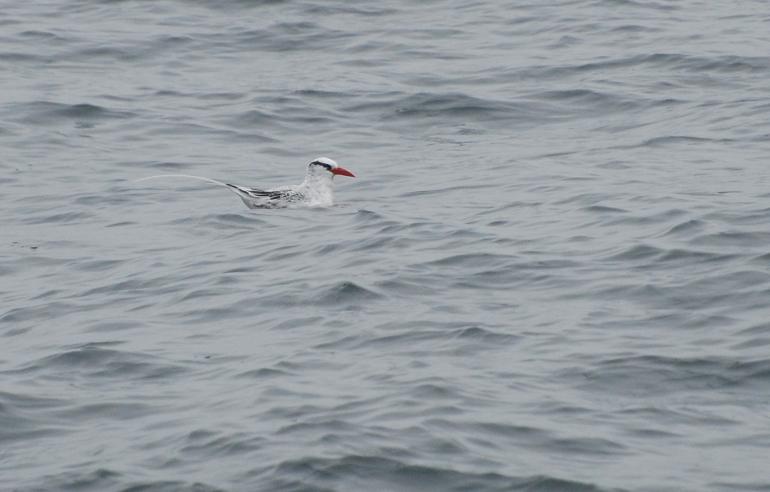
Once you start seeing Leach's Storm-Petrels on a California pelagic, it's probably safe to go asleep. They inhabit deep, deep water, the kind of water that is devoid of avian life except for Leach's Storm-Petrels. Seriously, once you get out a hundred miles, an hour may pass with twenty Leach's Storm-Petrels and nothing else. However, birders are attracted to these barren seas with hopes of finding some great rarity. Quality, not quantity. We managed to rustle up a couple Red-billed Tropicbirds to compensate for the scarcity of birds.

And now I shall return to my trusty pier, accumulating dollars in my bank account for other wonders. Wonders like The Essentials of Organic Chemistry.

Saturday, August 21, 2010

Two Seas


My meager savings account is devoted to exactly two things: textbooks (bleh) and pelagic trips. I hoard the paltry amount of money that I occasionally manage to scrounge up, only to blow most of it on pricey pelagic trips. Worth it? Check out that photo.

I really wanted to squeeze in one more pelagic trip before I move to landlocked Michigan. My comrade Tim Snieder also wanted to venture out on the high seas before he returned to Ontario, so we decided to fulfill our destinies and booked spots on the two-day pelagic out of San Diego last week.

It takes a different breed of birder to do pelagic trips. First, resistance to seasickness is helpful. I score well in this category; I've felt the slightest queasiness on only a couple of trips. Second, the pelagic birder must endure hours of boredom. Huh?

I won't lie. Pelagic trips are boring. Hours can stretch between sightings of interesting birds. On this trip, another of my young birder friends Kenny and I amused ourselves by keeping hourly lists of birds. The lowest number of species we tallied in an hour was three. We thought it was pretty funny that we were entertaining ourselves on a birding trip by birding.

Fortunately, every trip has its moments of excitement. Like when a Skua wings by...


Or when the leaders start bellowing "TROPICBIRD" over the intercom, sparking a mass-awakening of birder-zombies from the legions of camp chairs in the stern (sitting after hours of standing on a pitching deck is highly tempting, but it invariably leads to sleep.)


Birds aren't the only attraction of pelagic trips. Whales, seals, and fish compete with jaegers, shearwaters, and storm-petrels for attention. On this trip, we were treated to thirty-six Baird's Beaked-Whales, two Blue Whales, numerous Mola-Mola, Guadalupe Fur-Seals, and Pacific White-Sided Dolphins. It was a truly unforgettable experience that I will remember for the rest of my life.


(Incidentally, if that previous line sounded exceptionally corny, excellent perception! It's a direct quote from...ehhh, I'd better protect his reputation.)


Even the "boring" pelagic birds (like this gaggle of Pink-footed Shearwaters) are always fun to watch simply because they are only seen when you venture offshore.

Our journey did not end when we disembarked. Tim and I decided to drive east and bird a second sea: the Salton. The only hitch occurred when we couldn't find a grocery store to purchase food and drink to sustain us through the ordeal of birding the Salton. Eventually, we found a little Mexican market and stocked up on orange juice, cheese, and pineapple. We did not leave without filling a bag to the brim with warm Mexican sweetbread, which we mercilessly devoured as we sped eastward.

Actually, there was a second hitch: border patrol. We were the victims of a small amount of crap from a couple border patrol officers simply because they found out Tim is Canadian. 'Nuff said.

These minor mishaps could not prevent us from reaching the sea. I had spent the entire two-hour drive warning Tim of the ferocity of the heat, but he was still shocked by the dense wall of stinky heat that hit us as soon as we were vomited out of the air-conditioned bowels of the loyal Subaru. "They say pelagics are the final frontier of birding," he muttered as he slathered on sunscreen. "But I think THIS is the final frontier."


The Salton Sea would be nowhere near as famous among birders if Yellow-footed Gulls hadn't decided to randomly invade from Mexico and hang out at the sea in the summer. The Salton Sea is the only spot in the country where they occur. Tim easily ticked his first ones while the car was still moving. We celebrated by slaughtering the unfortunate pineapple and gobbling it down in one sitting. For the next hour, my mouth burned and I felt sick to my stomach.

And it wasn't even that good of a pineapple.


We endured the heat (at least, we like to think we did...Tim entered a state of dormancy at several points) and the pineapple's revenge, finding lots of other great birds. Wood Stork, Ruff, Gull-billed Tern, Black Tern, Lucy's Warbler, and Gila Woodpecker, to be precise. Dragonflies were also abundant. I finally saw my lusted-after Roseate Skimmer for the first time, and even photographed it before Tim promptly murdered it in cold blood.


While searching for the phantom Pyrrhuloxia in Brawley, we almost tripped over this beastly-looking dragonfly. It wasn't a clubtail (as I had hoped), but a White-belted Ringtail.


It was with relief that we realized it was getting dark and that we could leave for home. The air was still hotter than a grilled cheese sandwich fresh off the skillet; temperatures remained in the triple digits well after nightfall. After another very long drive, we were back at my house, coated in grease, sweat, and mud, and a bit dehydrated as well.

Heck, I think birding either sea takes a different breed!

Sunday, August 30, 2009

Pelagic Photos


Pomarine Jaeger at the Nine Mile Bank in San Diego County waters.


Elegant Terns. They range out surprisingly far into the ocean; we had one at least sixty miles offshore.


Fin Whale.


Sunset on the first day. Trust me, getting a photo with a horizontal horizon is no mean feat from a rocky boat.


Flying fish!


Black-footed Albatross. We had three of these wonderful birds following the boat all day Saturday.


Buller's Shearwaters were reasonable common well offshore.


Leach's Storm-Petrel.


During the slow periods, people would put a couple fishing lines off the back of the boat. We ended up with several fish, one of which was incorporated into Tuesday's day. Best fish I've ever tasted.


Wes Fritz, chummer extraordinaire.


Another Black-footed Albatross.


Common Tern.


Brown Booby. We encountered three Brown Boobies on this trip: one in Los Angeles County waters, one in Mexican waters, and most surprisingly, one in San Diego Harbor!


Brown Booby.


The Brown Booby in San Diego Harbor was a nice end to the trip!

Friday, August 28, 2009

The Deep Blue Sea


Earlier in the summer I signed up for a two-day pelagic trip out of San Diego run by Buena Vista Audubon. These long trips take you far out into the Pacific Ocean, out into the realm of petrels and albatrosses. John Garrett, Nora Papian and I departed Orange County in the early afternoon on Monday for the trip. I do not have much time to write, so I will just post a very brief report. I scored five lifers: Ashy Storm-Petrel, Leach's Storm-Petrel, Wilson's Storm-Petrel, Long-tailed Jaeger, and Arctic Tern. Other interesting pelagic birds we saw included Black-footed Albatross (photo at top of post), Brown Booby, Cassin's Auklet, Buller's Shearwater, and Pomarine Jaeger. We had some good non-bird sea life, including Fin and Blue Whales, Risso's and Common Dolphins, Flying Fish, and several species of fish that we caught.

I'll try to toss up some more photos later, though my schedule promises to be busy in the near future (school starts on Monday!)

Sunday, January 11, 2009

Fun at Sea

Not many pelagic (sea-going) birding trips are offered from Orange County, for a good reason: pelagic birding in Orange County is sub-par. Most people interested in seeing shearwaters, alcids, and other pelagic species usually head straight to more productive waters, such as Monterey or Fort Bragg. A few choice species are most easily found off Southern California, but even then Orange County is largely ignored in favor of places like Santa Barbara and San Diego. Obviously, this is bad news for someone trying to rack up a decent list for Orange County. Fortunately, Sea and Sage Audubon (of Orange County) runs a couple pelagic trips out of Dana Point every year. One was scheduled for January tenth, so I shelled out fifty bucks to reserve myself a spot on the boat.

I wasn't seriously expecting anything great - probably just Black-vented Shearwaters and Western Gulls - but heck, maybe we'd turn something up. My dad dropped me off at the Ocean Institute at seven-thirty on Saturday morning, and half an hour later the boat was underway. Before we had even departed the harbor, we had spotted Pacific Loons, Glaucous-winged Gulls, and Black Oystercatchers. Oystercatchers are always cool, no matter how many times you see them.


We hadn't gone far before a sharp-eyed birder pointed out the rare Pelagic Christmas-Tree swimming in the water. It was a pity a Christmas Shearwater wasn't sitting on top of it!


Some genuine pelagic birds appeared once we were a mile or two offshore. A smattering of Black-vented Shearwaters cruised by the ship on stiff wings. The boat flushed a couple Rhinoceros Auklets (small grayish birds with an unlikely name) off the water's surface. Several smaller grayish alcids gave us good views of their hindquarters as they desperately struggled to become airborne. Cassin's Auklets aren't very friendly. There was some brief excitement in the stern when a powerful Pomarine Jaeger (undoubtedly very big and squishy - JG) swept through the flock of gulls attending the boat. Nice birds, the whole lot - but ones that I had previously seen in Orange County.

The day took a turn for the better once we were about a dozen miles offshore. A pair of different alcids swimming ahead of the boat turned out to be XANTUS'S MURRELETS. This obscure black-and-white alcid was a life bird for me. This is a Southern Californian specialty, breeding only on the Channel Islands and off Baja California. They were a bit too distant for my three hundred millimeter lens to pull in. When I got home, I told my mom "I got a life bird today - Xantus's Murrelet." "Never heard of it," she replied.


The murrelets would have been enough to make the day noteworthy, but more surprises lay in wait for us. A short time later, a "dark" (read: Sooty/Short-tailed) shearwater sailed by the boat and landed nearby. After extensive study at close range, we positively identified it as a Short-tailed Shearwater. This species is rare in Orange County, though probably more regular than thought because of the dearth of Orange County pelagic trips and also confusion with the more common Sooty Shearwater.


It was difficult to produce any sightings on the level of the Xantus's Murrelets and Short-tailed Shearwater. We tallied more Cassin's Auklets, Rhinocerous Auklets, Pomarine Jaegers, and Black-vented Shearwaters, but the only new species we could find after a few more hours of puttering around the ocean was Common Murre. In the early afternoon, as we chugged back into the harbor, I turned around to see this at eye level.


Looking up, I saw this:


Then this:


And finally, this:


This cheeky first-cycle Western Gull didn't see the point of flying all the way through the harbor, so he decided to just kick back and enjoy a ride on the Sea Explorer while a bunch of weird birders snapped pictures of him from a few feet away.

My birding for the day didn't end when I stepped off the boat. I met my dad on the dock and we drove the short distance to Doheny State Beach, a famous spot for studying gulls. A Glaucous Gull, a big frosty gull with a funky name, had been seen there earlier in the week, and several of the birders on the boat had popped over to Doheney and seen the bird before the boat left in the morning! When we arrived, I started off down the beach, sifting through the hundreds of gulls loafing on the beach. After half and hour, I had seen only the expected species - California, Ring-billed, Heermann's, and Glaucous-wined Gulls. I climbed over a small hill and found several thousand more gulls hanging out in the mouth of the San Juan Creek. Up to now, the search had been manageable; now it was just crazy. Surprisingly, however, I spotted the target bird after only a few minutes. The Glaucous Gull was one of the closest birds, sticking out like a sore thumb: big and white with a bicolored bill. I got a photo of it beside a Glaucous-winged Gull for comparison.


Glaucous Gulls are birds of the north, only rarely wandering as far south as Orange County. This was another new county bird for me, my third for the day: the Xantus's Murrelets and Short-tailed Shearwater were also new. Additionally, I picked out a nice first-cycle Thayer's Gull and several Herring Gulls out of the vast flock, for quite the variety of gulls.

It was a great day. The pelagic trip didn't disappoint, producing a couple great species for Orange County. Additionally, it is always fun to see the more regular pelagic species. Interestingly, The Birds of Orange County: Status and Distribution lists twenty-five as the county high count for Cassin's Auklet; we saw at least three times that number. Very little is known about the seabirds of Orange County! I will jump at the next chance I can get for an Orange County pelagic. The lesson I learned: expect the unexpected, not just Black-vented Shearwaters and Western Gulls!