Pages

Showing posts with label Salton Sea. Show all posts

Monday, November 17, 2014

Map Monday: Mew Gull


1st-cycle Mew Gull from Mile Square Park, 1/1/12

I birded with Michael and Roger Woodruff yesterday. Twice I have birded with Michael; both instances involved date shakes (trust me, delicious!) and visits to the Salton Sea. Anyway, we found a Mew Gull at Tamarisk Lake at Desert Center. Happily unaware of the rarity of this species in the Riverside County deserts, we snapped a few mediocre photos without thinking too much of it. Turns out that it occurs once or twice per year in the county deserts--and usually at the Salton Sea. This sparked my curiosity about the bird's range.


The Desert Center Mew Gull, 11/16/14

Mew Gulls occur in the Eastern and Western hemispheres (though, there is disagreement about the status of the (sub)species--another one of those Green-winged/Common Teal conundrums). This map nicely illustrates their occurrence in Europe and North America--and it also illustrates the lack of coverage in Asia. It will be interesting to look at a map for this species in a decade or two once the eBird surge hits Asia.

Ah, North America. Like Varied Thrush last week, the Pacific Northwest seems to be the core of the reports. Records away from the Pacific Coast are scattered widely across the whole country.
Also, Mew Gull reaches the southern end of its (wintering) range in southern California (though, note the records from northern Baja and the Gulf of California--there would be more records if more people birded there. Perhaps it is not judicious to claim southern California represents the "southern edge" of ranges based on eBird maps. Hmm.)


Zooming in to California, we see that they stick pretty close to the coast, with the Salton Sea and the Central Valley the only places they wander far inland consistently. Closer to the coast (e.g., Los Angeles County, Orange County, western Riverside County) it consistently wanders inland a short distance, often frequenting small urban lakes.

Saturday, August 21, 2010

Two Seas


My meager savings account is devoted to exactly two things: textbooks (bleh) and pelagic trips. I hoard the paltry amount of money that I occasionally manage to scrounge up, only to blow most of it on pricey pelagic trips. Worth it? Check out that photo.

I really wanted to squeeze in one more pelagic trip before I move to landlocked Michigan. My comrade Tim Snieder also wanted to venture out on the high seas before he returned to Ontario, so we decided to fulfill our destinies and booked spots on the two-day pelagic out of San Diego last week.

It takes a different breed of birder to do pelagic trips. First, resistance to seasickness is helpful. I score well in this category; I've felt the slightest queasiness on only a couple of trips. Second, the pelagic birder must endure hours of boredom. Huh?

I won't lie. Pelagic trips are boring. Hours can stretch between sightings of interesting birds. On this trip, another of my young birder friends Kenny and I amused ourselves by keeping hourly lists of birds. The lowest number of species we tallied in an hour was three. We thought it was pretty funny that we were entertaining ourselves on a birding trip by birding.

Fortunately, every trip has its moments of excitement. Like when a Skua wings by...


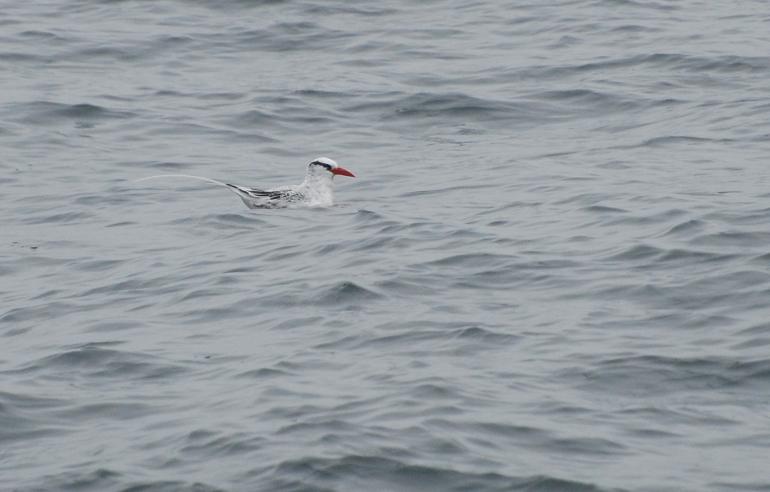
Or when the leaders start bellowing "TROPICBIRD" over the intercom, sparking a mass-awakening of birder-zombies from the legions of camp chairs in the stern (sitting after hours of standing on a pitching deck is highly tempting, but it invariably leads to sleep.)


Birds aren't the only attraction of pelagic trips. Whales, seals, and fish compete with jaegers, shearwaters, and storm-petrels for attention. On this trip, we were treated to thirty-six Baird's Beaked-Whales, two Blue Whales, numerous Mola-Mola, Guadalupe Fur-Seals, and Pacific White-Sided Dolphins. It was a truly unforgettable experience that I will remember for the rest of my life.


(Incidentally, if that previous line sounded exceptionally corny, excellent perception! It's a direct quote from...ehhh, I'd better protect his reputation.)


Even the "boring" pelagic birds (like this gaggle of Pink-footed Shearwaters) are always fun to watch simply because they are only seen when you venture offshore.

Our journey did not end when we disembarked. Tim and I decided to drive east and bird a second sea: the Salton. The only hitch occurred when we couldn't find a grocery store to purchase food and drink to sustain us through the ordeal of birding the Salton. Eventually, we found a little Mexican market and stocked up on orange juice, cheese, and pineapple. We did not leave without filling a bag to the brim with warm Mexican sweetbread, which we mercilessly devoured as we sped eastward.

Actually, there was a second hitch: border patrol. We were the victims of a small amount of crap from a couple border patrol officers simply because they found out Tim is Canadian. 'Nuff said.

These minor mishaps could not prevent us from reaching the sea. I had spent the entire two-hour drive warning Tim of the ferocity of the heat, but he was still shocked by the dense wall of stinky heat that hit us as soon as we were vomited out of the air-conditioned bowels of the loyal Subaru. "They say pelagics are the final frontier of birding," he muttered as he slathered on sunscreen. "But I think THIS is the final frontier."


The Salton Sea would be nowhere near as famous among birders if Yellow-footed Gulls hadn't decided to randomly invade from Mexico and hang out at the sea in the summer. The Salton Sea is the only spot in the country where they occur. Tim easily ticked his first ones while the car was still moving. We celebrated by slaughtering the unfortunate pineapple and gobbling it down in one sitting. For the next hour, my mouth burned and I felt sick to my stomach.

And it wasn't even that good of a pineapple.


We endured the heat (at least, we like to think we did...Tim entered a state of dormancy at several points) and the pineapple's revenge, finding lots of other great birds. Wood Stork, Ruff, Gull-billed Tern, Black Tern, Lucy's Warbler, and Gila Woodpecker, to be precise. Dragonflies were also abundant. I finally saw my lusted-after Roseate Skimmer for the first time, and even photographed it before Tim promptly murdered it in cold blood.


While searching for the phantom Pyrrhuloxia in Brawley, we almost tripped over this beastly-looking dragonfly. It wasn't a clubtail (as I had hoped), but a White-belted Ringtail.


It was with relief that we realized it was getting dark and that we could leave for home. The air was still hotter than a grilled cheese sandwich fresh off the skillet; temperatures remained in the triple digits well after nightfall. After another very long drive, we were back at my house, coated in grease, sweat, and mud, and a bit dehydrated as well.

Heck, I think birding either sea takes a different breed!

Saturday, July 4, 2009

YBC: Day Four


Last Thursday, on the YBC, we took the hottest (literally and figuratively) trip of the entire week. Like the trip out to Santa Cruz Island, it required a ridiculously early start time. The headlights of our vans burrowed through the dark mountains as we sped east toward the sea. The sun eventually rose, and through the smudgy van windows we spotted Burrowing Owls, Western Meadowlarks, and others.


By the time we finally reached our first destination, the Wister Unit, we were eager to jump out of the vans and begin to search for birds. Around the parking lot we found Black-tailed Gnatcatchers, White-winged Doves, Inca Doves, and Verdins. The most exciting bird here was a Bronzed Cowbird, a state bird for me.


The Salton Sea is also a rich area for dragonflies. Unfortunately, we had limited time and I spent most of my time birding rather than looking for dragonflies. Some of the species I noted in passing included Blue Dasher, Common Green Darner, Red Saddlebags (lifer), and Flame Skimmer. I paused to photograph this diminutive fellow and later identified it as a Rambur's Forktail (Ischnura ramburii.)


We worked our way along the southern edge of the sea, birding the entire way. The most exciting bird was a Wood Stork that flew over Davis Road, but unfortunately it kept flying and didn't land. Our next couple stops, the end of Schrimpf Road and Red Hill, produced many new species, including Snowy Plover, Cinnamon Teal, Laughing Gull, Yellow-footed Gull (a very exciting species for those who hadn't visited the sea before), and others.


The headquarters of the Sonny Bono Salton Sea National Wildlife Refuge is always worth a stop. The desert scrub around the visitor's center is a good place to find Common Ground-Dove, Verdin, and Gambel's Quail. We easily found all these. I managed to creep many people out with my very accurate imitation of the guy at the visitor center who once offered to show me the resident Barn Owl that roosts in one of the palms next to the visitor's center. I asked, "YA WANNA SEE A BAHN-AWEL?" and led the rest of the participants to the base of the owl's tree.


After a quick stop at Obsidian Butte that yielded nothing save chunks of obsidian, we headed south to check Fig Lagoon and Sunbeam Lake before starting back for San Diego. Unfortunately, a monstrous fire blocked the road to Fig Lagoon, so we had to turn around. It looked like a controlled fire to burn a field that had gotten out of hand.


Fortunately, no inferno prevented us from visiting Sunbeam Lake. A Greater White-fronted Goose and a Cackling Goose have been living with the domestic geese here for a couple years, and we easily spotted them upon exiting the vans. There was little else to be had there, save a single Common Moorhen and some swallows, so we hit the road and made the long, hot drive back to San Diego.

I suppose I'm a glutton for punishment with respect to unsuccessful owling. Several of the other campers had heard of our wild but mostly unfruitful owling escapade of the previous night and wanted to look for owls too. So, we looked for Western Screech-Owls down in the wash again, this time prudently taking the nice trail down to the trees. We almost heard them again, but not quite. The Common Poorwills and Barn Owls were still easy to find, and we also saw the first and only Great Horned Owl of the trip. I also managed to almost completely destroy my big toe by scraping it against an unseen speed bump. It scraped a nice chunk of skin and flesh away, leaving a oval raw patch of flesh on the tip of my toe. Ouch. We ended up staying out even later, and I didn't hit the sack until around one in the morning.

Sunday, March 8, 2009

Another Sojourn at The Sea

On Saturday, I had the opportunity to attend a day trip to the Salton Sea with the Junior Naturalists from Sea and Sage Audubon. I was just there less than a month ago with my dad and John Garrett, but birding around the Salton Sea is always worthwhile and I reckoned we might find a few different birds. I was right.

Instead of taking the boring freeway route to the sea through Riverside, we decided to take a more winding route through the mountains and desert of San Diego County. I met Kate Grabenstein (the head of the Junior Naturalists) and Alison George (one of the other Junior Naturalists) at the Audubon House in Irvine and we quickly set out. We met up with a few other Junior Naturalists at a rest stop near Oceanside, where I actually found some of my best photo opportunities of the day. A bunch of tame California Gulls and Red-winged Blackbirds roamed the parking lot, posing nicely for the camera.


After a lengthy drive through the heart of San Diego County, we pulled into the parking lot at Ocotillo Wells in the Anza-Borrego Desert. Birds were not very plentiful in this arid region.


We took a quick stroll through the surrounding desert to view the plentiful wildflowers. In a short time we found a variety of flowers, some with illustrative names, including Sand Verbena, Arizona Lupine, Brittlebush, Desert Sunflower, and Brown-eyed Primrose.


I also came across this gaudily colored lizard here. I was hoping it would be an exciting one I’d never seen before, but a quick check in my reptile field guide revealed that it was a Common Side-Blotched Lizard. All the lizards I photograph turn out to be Western Fence-Lizards or something with “common” in its name…


We drove the last few miles through increasingly desolate habitat towards the sea. It wasn’t until late morning that we arrived at Unit One of the Sonny Bono Salton Sea NWR at the end of Vendel Road. The thousands of Snow Geese present last month were nowhere to be found. The lack of geese was somewhat disappointed, though we did find Loggerhead Shrike, Sora, and Clapper Rail as consolation prizes.


Our growling stomachs demanded food, so we drove on to Obsidian Butte for a picnic lunch. Perched on rocks above the beach, we studied gulls, shorebirds, and ducks while munching on sandwiches. Again, there seemed to be fewer birds than last month, but still plenty to keep us occupied. Once we finished, we packed up the remnants of our lunches and headed on to the headquarters of the Sonny Bono Salton Sea NWR.

The patches of trees and bushes around the refuge headquarters provide some habitat for land birds, which are generally relatively scarce around the Salton Sea because of the lack of trees. It didn’t take long to spot an Abert’s Towhee, a new species for several of the other Junior Naturalists, clinging precariously from a feeder by the parking lot.


We wandered through the trees by the headquarters and admired the Eurasian Collared, Mourning, and Common Ground-Doves waddling around all over the place. Gambel’s Quail, White-crowned Sparrow, and Verdin were also rampant. A ranger from the refuge headquarters appeared out of nowhere and asked, “Wanna see a Barn Owl?” Of course we did. He directed us to a palm tree by the parking lot, and sure enough, a lovely Barn Owl was tucked back behind some of the fronds.


The long loop trail around the refuge was too alluring to resist, so we spent at least an hour hiking the loop. We finally found a few hundred Snow Geese, along with some Ross’s Geese, feeding in the big field by the observation tower. There were lots of birds in the ponds and on the seashore, but nothing really new. It was a long and hot walk back to the cars.

Red Hill, perhaps the single most famous (and even infamous) site at the Salton Sea, was next on our agenda. I couldn’t resist taking some cheesy landscape shots here.


The birds did not disappoint at Red Hill. Thousands of gulls, shorebirds, and ducks swarmed all over the mudflats and water around the marina. In short order we spotted the first Dunlin, Western Sandpiper, Western Grebe, Marbled Godwit, and Long-billed Curlew of the day. With my scope I managed to spot a Yellow-footed Gull resting on a mudflat at least half a mile away. It was soon joined by a Glaucous-winged Gull. Alison and I took off across the mudflat, which was nice and dry in most areas but treacherously slimy in other parts, in order to obtain photos of the Yellow-footed Gull. When we finally drew close to the gull, we discovered there were actually two Yellow-footed Gulls.


We could have easily spent the remaining daylight birding at Red Hill (there are so many thousands of birds to sort through!), but everyone else was interested in seeing Burrowing Owls. We sped over to the intersection of Sinclair and Blair Roads were my dad, John, and I saw a pair in February. On the way we happened across a burned field covered in Mountain Plovers, which was worth a quick stop to scope out. We located the Burrowing Owls without any trouble.


By now light was fading as the sun slowly sank toward the hills to the west. Kate, Allison, and I (everyone else had headed for home by this point) made a quick stop at the Wister Unit to see what was around. We were treated to a lovely sunset over the sea. I attempted to document it, but my camera did wacky things to the background.


Daylight was almost entirely gone by now, but we decided to take a cruise down Davis Road to see if we could hear anything. An American Bittern flushed from a roadside ditch as we slid past, and a short distance farther down a Clapper Rail was calling incessantly from a small patch of cattails near the road. In just a few more minutes of birding, we heard several more Clapper Rails, a few Soras, and a Common Moorhen. Now birding in utter darkness, we left the Wister Unit to the howling Coyotes (there were many) and started the homeward journey. I finally got home around nine-thirty.

It was, as every jaunt I’ve taken to the Salton Sea has been, an awesome trip. I didn’t see any life birds, but everyone else got at least one. I just enjoy seeing the sea and all the birds it hosts. I can’t wait for my next trip over there, which probably won’t be until next winter; in the summer, the sea smells horrific and the temperatures are crushingly hot.

Thursday, February 19, 2009

See Ya at the Sea - Part III

I was awoken from my slumber by the chirpy calls of a Verdin. County bird, I thought as I groped for my watch. Six-thirty! Uh-oh, we overslept a few minutes. Turns out I forgot to set the alarm. I wiggled my way out of my cozy sleeping bag, shook my dad awake, and crawled through the tiny tent flap. It was a beautiful sunny morning, calm and crisp. A short distance away, on the glassy surface of the Salton Sea, flocks of American White Pelicans glowed in the sunlight.


I roused John by hurling clods of dirt at his tent, and we began breaking camp. It took only a few minutes to tear down the tents and stuff away the sleeping bags. John and I sprinted over the beach. The most obvious birds were the pelicans.


Other birds were present in large numbers: Eared Grebes, gulls of several flavors, and others. We found the third-cycle Lesser Black-backed Gull right where we left it at the southern end of the campground. It was accompanied by a Herring Gull, some California Gulls, and a Glaucous-winged Gull (another new county bird!)


We bade goodbye to our campground and headed north along the edge of the sea. We took a brief spin through the Salton Sea State Recreation Area Headquarters, where we found this first-cycle Thayer’s Gull (a rather dark individual.)


John spotted a very odd gull perched on a post in the marina. It had a strongly bi-colored bill like a Glaucous Gull, but the body and wingtips were dirty grayish brown, more like a Glaucous-winged Gull. John and I eventually came to the conclusion that it was a Glaucous x Glaucous-winged hybrid, an aberrant Glaucous-winged Gull, or something entirely different.


We decided to leave the Salton Sea entirely and stop at the San Jacinto Valley on the way home. John Garrett had guaranteed we would see Mountain Bluebirds around the Salton Sea, but he was wrong. We didn’t see a single Mountain Bluebird anywhere around the Sea all weekend. I knew of a small flock wintering at the San Jacinto Wildlife Area, conveniently just off the freeway on the way home. We spotted three (!) Ferruginous Hawks circling over a field soon after exiting the freeway. We ended up seeing at least a dozen in just a couple hours of birding the San Jacinto Valley.


As we were cruising down Davis Road through some nice fields, I spotted a sky-blue bird perched on a telephone wire right along the road. “Mountain Bluebird!” I shouted joyfully. There was actually a small flock of them. Lovely birds, and another new one for my life list (Mountain Bluebird was a rather embarrassingly absent from my list prior to the trip.)


The San Jacinto Wildlife Area has a very enjoyable auto loop through some nice freshwater ponds and marshes. We were pressed for time, but the loop produced some great birds for us: Blue-winged Teal, Hooded Merganser, Prairie Falcon, and Yellow Warbler. There were thousands of other ducks present. The only other marginally-decent photo I obtained here was of a Loggerhead Shrike stationed on a bush beside the road.


It was now nearly midday, and we needed to be home by mid-afternoon. We made a brief stop at Lake Perris to search for Glaucous Gull, which John Garrett direly needs for his life list. We had no luck finding it, but did get a few new species for the trip: Common Merganser, Ring-necked Duck, and Forster’s Tern.

All of us were saddened to pull into the driveway back at home. It was an amazing trip. I personally saw three life birds (Mountain Plover, Chestnut-collared Longspur, and Mountain Bluebird) and a bunch of new species for the state and Riverside and Imperial Counties. I look forward to visited the Salton Sea again in the future!

Tuesday, February 17, 2009

See Ya at the Sea - Part II


Our trusty Ford Windstar jolted its way down the rough gravel road and into the parking lot of the Sonny Bono Salton Sea National Wildlife Refuge Headquarters (say that twenty times really fast.) John Garrett, my dad, and I piled out of the car, followed by a cascade of maps, food wrappers, and goldfish crackers. As we squinted in the bright sun of the early afternoon, we were greeted by the calls of Gambel’s Quail, Verdin, and Common Ground-Dove. John and I proceeded to poke around the bushes, attempting to photograph the ground-doves and quail.


I realize that we didn’t drive all the way to the Salton Sea to look at Mourning Doves, but I came across this incredibly cooperative Mourning Dove sitting on the ground (thus making it a ground-dove) near the parking lot.


As productive as the headquarters can be for birding (a Cave Swallow had been spotted here earlier this winter), we decided to move on because there didn’t seem to be a lot of birds around (or, at least not as many birds as we could find elsewhere.) Our next destination was Obsidian Butte. This place is aptly named, since it is a genuine butte scattered with hunks of obsidian and pumice from an extinct volcano. Obsidian Butte also happens to be one of the best spots for gulls around the Salton Sea. We were excited to see the swarms of gulls as we drove up. John quickly spotted our second (!) Lesser Black-backed Gull of the trip on a rock just offshore, and I answered by pointing out two Yellow-footed Gulls hanging out with some pelicans on another rock.


After sifting through the gulls at Obsidian Butte for roughly a half-hour more, we continued to work our way south, hugging the shore of the Salton Sea as closely as possible. We found a Surf Scoter at the end of Young Road, a decent bird for Imperial County.


The extensive mudflats near the end of Bowles Road produced thousands of shorebirds: lots of Black-bellied Plovers, Western Sandpipers, and Stilt Sandpipers (another new state bird for me), along with lesser numbers of other species. By now it was mid-afternoon, and we realized that we’d better hustle along if we wanted to hit all the places we wanted to.

Several miles later and we were driving down Vendel Road, the entrance to Unit One of the Sonny Bono Salton Sea National Wildlife Refuge (another tongue twister!) We began seeing small parties of Snow Geese flying over the road up ahead, but we didn’t realize exactly how many geese there were until we passed a field full of them. There were thousands of Snow and Ross’s Geese!


The cries of the geese exploding into the air were deafening. Geese were everywhere I looked – in the fields, swimming in the ponds, and flying overhead. I merrily clicked away at geese flying over while John looked on in jealousy, since his camera had run out of battery.


A roar of another goose flock behind us caused us to turn, and we were astounded to see a white tornado of geese rising out of a field on the other side of the road.


Recovering from the sight, we looked around at the other species in the area. Two Tundra Swans were foraging in a pond nearby. These two individuals have been present most of the winter in this same pond. Tundra Swans are relatively rare in southern California, and it was yet another new state bird for me.


We continued to the end of Vendel Road, where there is a small parking lot and observation platform. Hundreds of assorted ducks were floating around in the ponds surrounding the tower, and several Clapper Rails (of the “Yuma” subspecies) and a Sora sounded off from the cattail-choked pond adjacent to the parking lot. A young Bald Eagle flew by, much to our excitement.


Despite the massive quantities of birds, we were forced to move on, since I wanted to bird Brawley before sundown. One could easily spend a full day birding each individual place we stopped, so just one day to bird the south end of the Salton Sea isn’t sufficient. As we were driving out of the refuge along Vendel Road, we had to stop to avoid a big flock of Eurasian Collared-Doves that were walking around in the road for some reason. There was one much paler bird among them: a Ringed Turtle-Dove.


The last birding spot of the day was Cattle Call Park in Brawley. This unassuming little park tucked in the middle of Brawley has hosted a few notable birds recently, included Gray Flycatcher, Red-naped Sapsucker, and Vermilion Flycatcher. It is also one of the most convenient places in the entire state to find Gila Woodpeckers. We managed to quickly locate the Gray Flycatcher despite a loud and obnoxious family picnic right where the flycatcher usually hangs out.


It didn’t take much longer to find the Gila Woodpeckers. We located them by their squeaky calls, a sound I hadn’t heard since my trip to Arizona over two years ago. Two were fussing around in some trees in the park, but unfortunately they didn’t come out into the open.


We found Cactus Wrens, Abert’s Towhees, Verdins, American Kestrels, and even a Great Horned Owl in the half-hour we puttered around the park. By now it was nearly dusk, and we were hungry for dinner. Our breakfast was a meager affair – mini-muffins and granola bars. Our lunch wasn’t much better. So, there were three hungry birders to feed! We attempted to stop at a steakhouse in Westmoorland, but an ominous sign on the door reading “Reservations Only” made us think that they wouldn’t cater to mud-splattered and soot-coated birders. After a long search, we finally found a little steakhouse at the Calipatria Inn in Calipatria (surprise, surprise) where we dined on decent tri-tip steak before driving north to our campground for the night.

Thus ended our birding on Saturday. It was a really awesome day of birding; we saw many great birds, included two lifers for me: Mountain Plover and Chestnut-collared Longspur. Stay tuned for part three!