Pages

Saturday, August 21, 2010

Two Seas


My meager savings account is devoted to exactly two things: textbooks (bleh) and pelagic trips. I hoard the paltry amount of money that I occasionally manage to scrounge up, only to blow most of it on pricey pelagic trips. Worth it? Check out that photo.

I really wanted to squeeze in one more pelagic trip before I move to landlocked Michigan. My comrade Tim Snieder also wanted to venture out on the high seas before he returned to Ontario, so we decided to fulfill our destinies and booked spots on the two-day pelagic out of San Diego last week.

It takes a different breed of birder to do pelagic trips. First, resistance to seasickness is helpful. I score well in this category; I've felt the slightest queasiness on only a couple of trips. Second, the pelagic birder must endure hours of boredom. Huh?

I won't lie. Pelagic trips are boring. Hours can stretch between sightings of interesting birds. On this trip, another of my young birder friends Kenny and I amused ourselves by keeping hourly lists of birds. The lowest number of species we tallied in an hour was three. We thought it was pretty funny that we were entertaining ourselves on a birding trip by birding.

Fortunately, every trip has its moments of excitement. Like when a Skua wings by...


Or when the leaders start bellowing "TROPICBIRD" over the intercom, sparking a mass-awakening of birder-zombies from the legions of camp chairs in the stern (sitting after hours of standing on a pitching deck is highly tempting, but it invariably leads to sleep.)
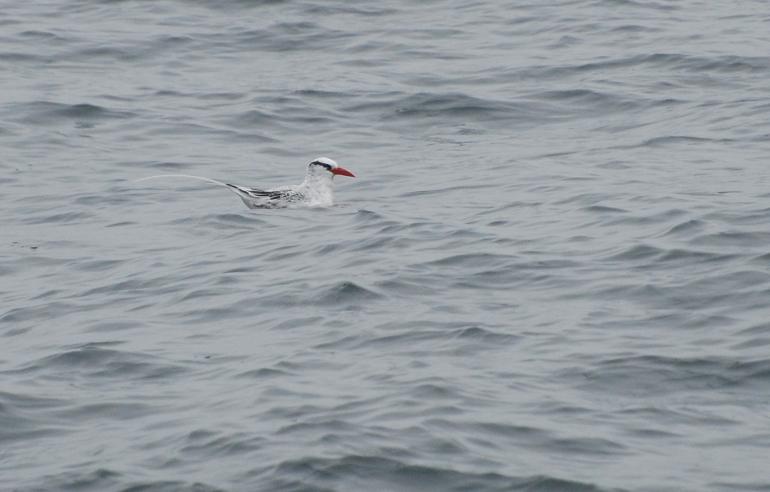


Birds aren't the only attraction of pelagic trips. Whales, seals, and fish compete with jaegers, shearwaters, and storm-petrels for attention. On this trip, we were treated to thirty-six Baird's Beaked-Whales, two Blue Whales, numerous Mola-Mola, Guadalupe Fur-Seals, and Pacific White-Sided Dolphins. It was a truly unforgettable experience that I will remember for the rest of my life.


(Incidentally, if that previous line sounded exceptionally corny, excellent perception! It's a direct quote from...ehhh, I'd better protect his reputation.)


Even the "boring" pelagic birds (like this gaggle of Pink-footed Shearwaters) are always fun to watch simply because they are only seen when you venture offshore.

Our journey did not end when we disembarked. Tim and I decided to drive east and bird a second sea: the Salton. The only hitch occurred when we couldn't find a grocery store to purchase food and drink to sustain us through the ordeal of birding the Salton. Eventually, we found a little Mexican market and stocked up on orange juice, cheese, and pineapple. We did not leave without filling a bag to the brim with warm Mexican sweetbread, which we mercilessly devoured as we sped eastward.

Actually, there was a second hitch: border patrol. We were the victims of a small amount of crap from a couple border patrol officers simply because they found out Tim is Canadian. 'Nuff said.

These minor mishaps could not prevent us from reaching the sea. I had spent the entire two-hour drive warning Tim of the ferocity of the heat, but he was still shocked by the dense wall of stinky heat that hit us as soon as we were vomited out of the air-conditioned bowels of the loyal Subaru. "They say pelagics are the final frontier of birding," he muttered as he slathered on sunscreen. "But I think THIS is the final frontier."


The Salton Sea would be nowhere near as famous among birders if Yellow-footed Gulls hadn't decided to randomly invade from Mexico and hang out at the sea in the summer. The Salton Sea is the only spot in the country where they occur. Tim easily ticked his first ones while the car was still moving. We celebrated by slaughtering the unfortunate pineapple and gobbling it down in one sitting. For the next hour, my mouth burned and I felt sick to my stomach.

And it wasn't even that good of a pineapple.


We endured the heat (at least, we like to think we did...Tim entered a state of dormancy at several points) and the pineapple's revenge, finding lots of other great birds. Wood Stork, Ruff, Gull-billed Tern, Black Tern, Lucy's Warbler, and Gila Woodpecker, to be precise. Dragonflies were also abundant. I finally saw my lusted-after Roseate Skimmer for the first time, and even photographed it before Tim promptly murdered it in cold blood.


While searching for the phantom Pyrrhuloxia in Brawley, we almost tripped over this beastly-looking dragonfly. It wasn't a clubtail (as I had hoped), but a White-belted Ringtail.


It was with relief that we realized it was getting dark and that we could leave for home. The air was still hotter than a grilled cheese sandwich fresh off the skillet; temperatures remained in the triple digits well after nightfall. After another very long drive, we were back at my house, coated in grease, sweat, and mud, and a bit dehydrated as well.

Heck, I think birding either sea takes a different breed!

Sunday, August 15, 2010

Sierras = Serious Fun


You could say it was love at first sight. My birding experiences in the Sierra Nevada have been very limited, but enough for me to thoroughly fall in love with this range. Sadly, the distance prevents us from establishing a deep relationship.

Now, every August my church holds a weeklong, family-oriented camp just outside Yosemite. It sounded fun (and the prospects of a bit of birding in the Sierras was alluring), so I hitched a ride up with friends (yup, my family wimped out of the camping...so much for family camp.)

The definite highlight was an epic hike to Cathedral Lake and Tresidder Peak. It wasn't a particularly long hike (just over five miles), but it was a 1900 foot climb to the peak and a 2100 foot drop to our end point. Add the fact that most of the hiking was off-trail complete with obstacles such as fallen logs, boulders, and snow banks to negotiate...


Perhaps it was a good thing birds were scarce on this hike; too many avian delights would have caused me to involuntarily lag behind. However, the hike still provided the best bird encounter of the trip. We had paused to catch our breath after a particularly steep segment (the nice thing about hiking at high elevations is you can blame any physical shortcomings on the elevation) when someone remarked, "Hey, look at the little Wild Turkey!"

Hold on a sec, pal. Wild Turkeys don't live in lodgepole pine forest at nine thousand feet. I whirled around and gaped.


Ever been so excited that you feel a tad dizzy? This only rarely happens to me-- so perhaps it was the elevation. This lovely chicken is a displaying male Sooty Grouse. I've searched for them many times with little success. I snagged a brief glimpse when I flushed one after a wild grouse hunt in the Greenhorn Mountains in July. That experience was so un-fulfilling that this second grouse felt like a life bird. Better, even. My friends watched with fascinated horror as I crawled around after the bird with my camera. It took them several minutes to pry me away.

The grouse would have been enough to make the hike entirely worthwhile, but the scenery competed with birds for sheer awe, if that's even possible. Words, photos, and telepathic communication cannot describe the majesty and beauty of these mountains. Do the hike yourself and tell me what you think. You'll be at loss for words for at least a week.

The hikes, as awesome as they were, weren't the only birding opportunities. I found sixty-one species on my daily morning rambles around camp at June Lake. Sixty-one juicy, delicious species like Northern Goshawk, Williamson's Sapsucker, White-headed Woodpecker, Virginia's Warbler, and Townsend's Solitaire.


Not included in the species tally were mammals, butterflies, dragonflies, trees, or Klingons. Golden-mantled Ground-Squirrels were ubiquitous around the campground.


The bird life around June Lake was an interesting mix of breeders and early migrants and dispersing birds from elsewhere. Yellow-rumped Warbler reproduction was evidenced by the abundant streaky juveniles puttering around after their heavily molting parents.


I enjoyed the numerous Brewer's Sparrows, a species I am privileged to see only intermittently. It wasn't unusual to see twenty in an hour of hiking from camp.


Perhaps my most unusual find at June Lake was this Virginia's Warbler. It seemed out of place, and a bit of research revealed that it was. Ephemeral breeding populations occasionally exist in this area, though this bird was more likely a wanderer from elsewhere.


The lake itself was rather dull for birding (but excellent for swimming and canoeing!) Small numbers of California Gulls commuted from Mono Lake to loaf on June Lake, supplementing the poor diversity of waterbirds: Mallard, Spotted Sandpiper, Black-crowned Night-Heron, and the occasional Osprey.


I'm embarrassed to admit that I neglected butterflies, only photographing the occasional one in passing. One of my favorites was this Sierra Sulphur. They were common up on the alpine tundra near Gaylor Lake.


If I neglected butterflies, I almost ignored plants. Ah, well.


I will conclude with a few maxims on camping. Never take showers when icy plunges into natural bodies of water are available. It's like cheating. Heck, it is cheating! Always have an abundant supply of tortillas, peanut butter, and bananas at your disposal. And finally, keep pine needles out of your sleeping bag.

Thursday, August 5, 2010

Sagging Spirits

Orange County's lowly Santa Ana Mountains are generally ignored by birders in favor of the bigger, more exciting mountain ranges like the San Bernardinos or San Jacintos. For a legitimate reason, too: the Santa Anas do not rise high enough to host specialties like White-headed Woodpeckers, Dusky Flycatchers, or Cassin's Finches. In comparison with their taller neighbors, the Santa Anas are downright boring.

But!

Upper Silverado Canyon, only a twenty-minute drive from my house, offers a nice serving of mountain birding within Orange County. It seems that I stumble upon something exciting every time I head up there--Green-tailed Towhee, Painted Redstart, breeding Olive-sided Flycatchers, Lewis's Woodpecker...

But...

I haven't learned my lesson. I kept intending to visit the canyon all summer, but I kept putting it off, figuring there was nothing new to see. Boy, was I wrong.

It was shaping up to be pretty average morning. Sure, a few highlights: Canyon and Rock Wrens, a whole mess of Western Screech-Owls before dawn, and several Olive-sided Flycatchers. All neat birds, and some of them extremely local in Orange County in the summer. Still...this is a tad disappointing, I thought as I gazed out over the canyon to the fog-shrouded lowlands below.

Tik, tik. Whaaaaat...?

The bird was invisible, so I blast it with my most irresistible pish mix.

Pssshhh psh pssshhhhhhhpshhhpshhh PSSSHHH PSSHHHHHHHHHHH

My opponent hesitated for a moment, and then popped up and launched itself at me. It landed in a bush about fifteen feet away. It was a sparrow, it was a....

HOLY SMOKES, A SAGE SPARROW!


I've lived in Orange County for three years without seeing one. Legends of their continued existence deep in impenetrable tracks of the Santa Anas constantly circulate, but finding one borders on impossible. A most excellent way to save the morning, no?

Thomas Jefferson looked upon my success with stern approval.


I built a stone cairn to mark the spot in case other birders wished to search for this phantom sparrow. Tommy did his part.


A side effect of my pishing assault was an infestation of spunky Blue-gray Gnatcathcers. This bright-eyed little gnome landed at arm's length.


By late morning it was hot, dusty, and I was more than ready for lunch, so returned to my (err, my mom's) extremely rugged Subaru and coasted down the mountain. Driving this battered dirt road is fun--you just have to watch out for steep drop-offs, random boulders in the road, and suicidal Mountain Quails.

I wasn't hungry enough to skip a brief search for butterflies lower in the canyon. The paucity of butterflies this late in the summer is yet another reason why I should have visited the canyon earlier. Ah well, you learn from your mistakes...right?


California Dogface


California Sister

Tuesday, August 3, 2010

The Beginning of the Beginning

I took a deep breath, shoved open the heavy door, and practically swam out into the muggy Michigan evening. Almost instantly, a House Sparrow fluttered by my face, its chirping a triumphant cackle to my ear.

Darn. I had been hoping for a somewhat more audacious beginning to my campus list.

Ah well. At least things were only going to get better. And they did! First, a robin, then a Downy Woodpecker...

College orientation. Supposedly, a time to meet people and learn about the transition into college. For me, it meant getting a head start on my campus list for Calvin College. What else is there to do other than bird when you arrive on campus a couple hours before orientation even begins?

I jaywalked across the East Beltline for the first time ever and plunged into Calvin's ecosystem preserve. Chipping cardinals and cackling catbirds greeted me as I entered the brushy fringe of the preserve. As I ventured deeper into the forest, I added new species to my campus list right and left: Black-capped Chickadee, Tufted Titmouse, Red-eyed Vireo, Ruby-throated Hummingbird...

It would have been paradise except for the plentiful mosquitoes and deerflies. I swatted at them (I do not subscribe to the view that simply letting them suck alleviates the itching) as I strolled down the wood chip path, enjoying the evening serenade of wood-pewees and recognizing the familiar leaves of elms, beeches, and hickories. I was almost in a trance; it felt like those three years in California didn't exist and I had always resided in Michigan.

Whoops, eight forty-five! I was already late for the first orientation event. It's a good thing this is a birding blog--writing about orientation would take up way too much time!

The official campus list stands at thirty-five. Watch for updates beginning on August 30th!

Saturday, July 17, 2010

Condor Quest


I didn't know what I was getting myself into. When I called my buddy Tim a couple days prior to our already spontaneous roadtrip, I was expecting that we'd just maraud around the southern Sierra Nevada as we did last time. Tim, however, had other ideas.

"Wanna go see condors?" he asked.

"Big Sur? Sure!" I replied, only vaguely aware that Big Sur is a five-hour drive from Weldon (which, in turn, is over three hours from my house.)

We did not, however, limit ourselves to condors. Instead, we roamed and rampaged central California, finding lots of other interesting creatures: Sooty Grouse, Flammulated Owl, Sea Otters, Spotted Owl, Humpback Whale, Burrowing Owl, Purple Martin, Elephant Seal, Snowy Plover, Black Swift...

You get the idea. It was a fabulous trip. The condors, however, were the pinnacle of the expedition (well, except maybe for that pizza.)

The road through Big Sur is treacherous. In addition to the numerous bikers, backpackers, and the occasional Segway you have to avoid, the highway is more twisted and bent than a yoga extraordinaire. Around one rather ordinary-looking curve we swung, and WHAM--a California Condor was circling a mere hundred feet over the road. My brain was too flabbergasted to fully analyze the situation, so I simply began bellowing to attract Tim's attention. I hastily (and perhaps just a wee bit recklessly) swerved off the road to a dirt pulloff, and we scuttled from the car faster than mice being pelted with hats.


Whooping with delight, we watched the gargantuan bird lazily soared just overhead. Those long wings, the splayed primaries, the pathetically short tail, the gray head (it was an immature)...we soaked in every detail. Eventually, the beast began drifting south, so we hopped into the Subaru (our starship of choice) and pursued it along the coastline.

This time it was Tim who started shouting. "MORE!" he screamed, wildly gesturing at a fog-shrouded hillside. The condor had been joined by four more. They spiraled in a captivating wheel, shimmering in and out of the fog until they were mere specters.


Tim described it as the best moment of his life. I'm not sure I agree...but it was pretty darn awesome.

Thursday, July 15, 2010

Summer: Sewage, Shorebirds...


Pumping my legs furiously, I crest the hill. Underpasses are short but steep; my quads tingle as I crank into higher gear and lazily peddle onward. Wiping the sweat from my forehead, I lean back and stop peddling, allowing momentum to carry the bike forward. I lift up my jersey to feel the cool breeze on my bare chest. Ahhhh—it’s a perfect summer morning: warm, but not uncomfortably so, the sun already high in a completely clear sky.

It would be beautiful, except for the setting.

I glance to my right and behold the mighty San Diego Creek. Creek is a misnomer; it is a large concrete ditch with a trickle of trash (and maybe a bit of water) fermenting in the bottom. Plastic bottles, shopping carts, and algae mats top the menu. The only sign of life is a band of ragged Mallards sifting through the goo. Two dead ones fester in a puddle nearby. I pause and stare at the puddle. I can’t decide whether it’s green or black.

Not only is it an eyesore; this lovely stew smells exactly the way you would imagine it to.

I’ve become accustomed to the sight, smell, and taste of the creek. In fact, I’ve embraced it as a worthy birding spot. Hooded Mergansers often winter in this particular puddle, and migrant shorebirds sometimes stop on the radioactive heaps of slime.

Shorebirds! It’s July, a supposedly boring time of year to go birding. The breeders have been around long enough to become wearisome, and nothing is migrating. Well…not actually. Shorebirds begin sneaking south by mid-June, and by early July the beaches and mudflats swarm with them. They’re not pristine juveniles; the worn adults dominate the scene until mid-August. Still, I enjoy sorting through the battered adults. Each one is unique. This Willet has replaced most of the feathers on the breast, and that one has retained extensive barring…

My ponderings are broken when a tiny sandpiper bursts from a pool of sludge. Breeep? It asks as it careens down the creek. Least Sandpiper! As I watch it disappear down the channel, I try to imagine it on the tundra. Boasting crisp alternate plumage, perhaps it strutted beside an ice-choked pond in hopes of attracting the perfect female. Perhaps it frantically scolded and fluttered by its nest, attemping to distract a lumbering caribou, or polar bear, or shorebird researcher…

But now it’s puttering around a pathetic ditch in the heart of Orange County.

It’s summer. It’s shorebird season.

Tuesday, July 6, 2010

Colorado Is for the Chickens


I never warned you.

Colorado. A wonderful place. For nearly three weeks I ravaged the state, destroying target birds right and left. The first ten days I stayed with Marcel Such and his family in Lyons (thanks, guys, for putting up with me for that long!) and the last seven days were devoted to Camp Colorado (thanks, Sea and Sage Audubon and American Birding Association for the scholarships!)

Naturally, all this birding and marauding created heaps of stories.

Ask me to tell you one next time I see you, because I don't have time right now!

That's because I'm embarking on another road trip with my friend Tim tomorrow. The day after I return, I begin volunteering at nature day camps for kids for the next two weeks. After that, I have a week-long college orientation trip...

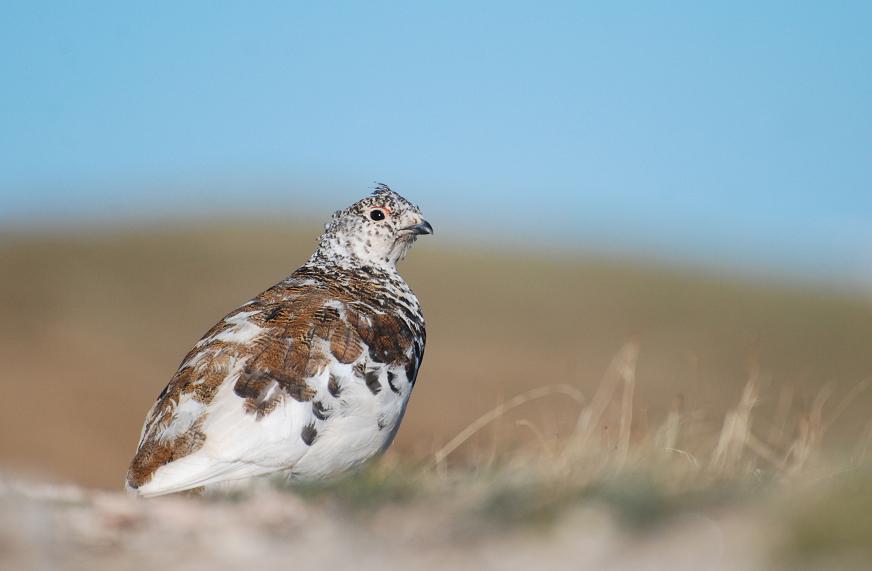
You get the idea. I'll probably never get around to writing a full report for the trip. Oh well. In the meantime, enjoy these two miniature stories. The first is about the ptarmigan (photo at top.) These dapper little chickens are legendary among birders. They're tough to find--supposedly. Marcel, his brother Joel, and I had no trouble finding several of these quizzical chickens quarreling on the tundra up by Trail Ridge Road in Rocky National Park. The birds ignored us as they chased each other around, and at one point one of them almost landed on my boot.


Perhaps even more miraculous was our run-in with this Dusky Grouse. They're possible just about anywhere--and supposedly, you'll encounter one if you hike around enough in their habitat. Well, we hiked for a week in the mountains with no luck--until we came across this gorgeous displaying male. Joel and I plunged into the dark, mosquito-infested forest and stalked it as it displayed in the shadows. It largely ignored us. Have you ever had a Dusky Grouse stroll within two feet of you as you kneel amid sweet pine needles?

It's one of those things that you just have to experience for yourself. If you have, great. If you haven't? Too bad.

(Hehe.)

More later. So long, and thanks for the orange juice.